




The collaboration between Don Alessio Fucile, an art expert, and the Shalom blog continues. Don Alessio will guide us in exploring the most important moments of the liturgical year through beautiful works of art that, in addition to inspiring wonder at their splendor, can help us better understand Sacred Scripture and the message of Jesus.
Today Don Alessio presents Caravaggio’s masterpiece, the “Conversion of Saint Paul,” from 1602, which is located in the Church of Santa Maria del Popolo in Rome to celebrate today’s feast.
“From darkness to light”: this is the journey of Paul of Tarsus, one of the most extraordinary figures in history. The way Christ called him to become his apostle is fascinating. Immediately after Christ’s death, he took part in the persecution of Christians and is mentioned in the Acts of the Apostles among those who witnessed the stoning of Stephen. Through his influence and authority, he obtained permission to arrest the followers of the new religion and take them to Jerusalem. While traveling to Damascus, he had a vision that led to his astonishing conversion.
The scene of the conversion
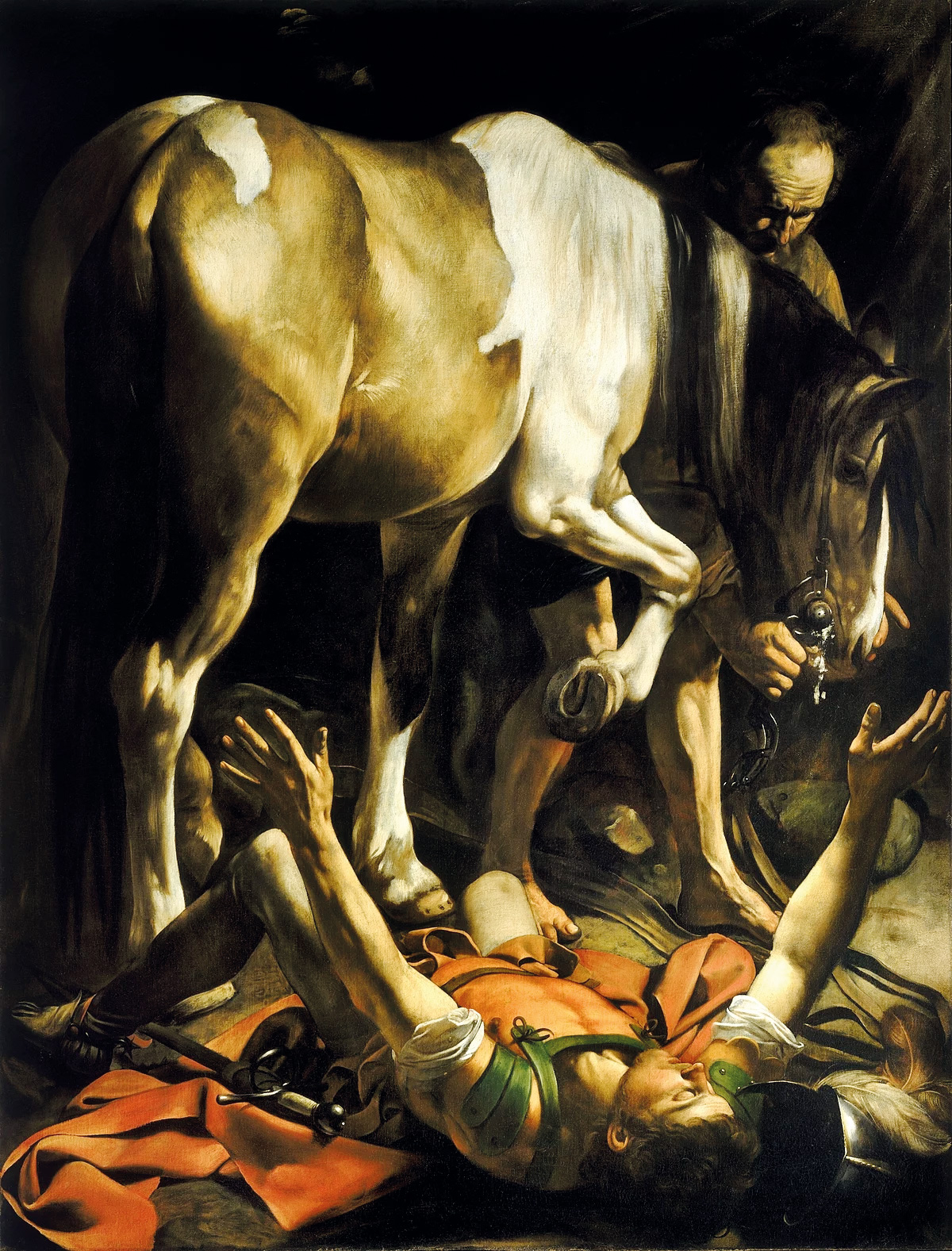
The celebrated painting created by Merisi depicts the moment immediately following the miracle.
Paul is on the ground, having just fallen from the horse, wearing a soldier’s armor, as described in the Acts of the Apostles.
His outstretched arms express profound astonishment. The presence of the horse, which occupies almost the entire scene, is an invention of the artists: the Acts of the Apostles do not mention it; it serves to heighten the drama of the event.
Paul’s redemption begins at the moment he loses control of the horse and his power, and is thrown from the saddle. His sword on the left is far away and cannot protect him. Even the cloak so often billowed by the wind as he raced forward, caught up in illusory certainties, now lies deflated, a useless rag from a past that has been erased. He who once sat proudly above is now on the ground; his pride has been humbled, and the man is at the mercy of the animal, which could suddenly crush him beneath its hooves.
Paul’s journey of redemption begins with this defeat. The arms indicate welcome, announcing that long-awaited, decisive, and definitive embrace with the Light that unhorsed him.
Another unusual element is the groom, barefoot and deeply wrinkled, intent on restraining the horse and indifferent to the event. Paul’s eyes are closed; struck by the vision, he will remain blind for three days, until Ananias lays hands on him and his eyes are opened through Baptism.
Caravaggio’s Originality
The altarpiece’s originality is emphasized by the everyday nature of the event: the trappings that would have given the scene emphasis and spectacle are absent. There are no typical elements of a supernatural vision.
Despite this, Paul is no longer the same, even though he is still unable to see the new reality, as his gesture of astonishment emphasizes. The light symbolizes divine Grace breaking into the darkness of sin, represented by the dark background, which also serves to bring out the figures’ sculptural volumes. The light is also a metaphor for the new existence about to begin for Paul, after an experience shrouded in darkness in which violence, suspicion, betrayal, deceit, and death held sway: a remarkable autobiographical note painted into the artist’s own tormented life. God takes the ground from beneath Paul’s feet so that he may fall into his arms.
The Work’s Message
Certain lessons that life imposes help us find ourselves again and give meaning to our story. Some events arrive by smashing through the glass! However, this is not God’s usual way of acting. He fully respects the freedom of his children and does not force them to love him. I like an image from Revelation that presents Jesus, patient and merciful, standing firmly at the door of the heart, knocking and asking to enter so that he may dine with people. The same “light” that struck Paul, bursting directly from the same canvas, comes looking for you, calling you, capturing you, questioning you.
Have you ever been “struck down” by God, who opened your eyes to certain aspects of your life that weren’t right?
Tell us in the comments!


