




The collaboration between Father Alessio Fucile, an art expert, and the Shalom blog continues. Father Alessio will guide us in exploring the most important moments of the liturgical year through beautiful works of art which, besides inspiring wonder at their splendor, can help us better understand the Holy Scriptures and the message of Jesus.
Today, Father Alessio presents the “Sacred Heart,” a work by the painter Pompeo Batoni. This small oval painting, executed in oil on copper in 1767, is currently kept in the Church of the Gesù in Rome.


The artist and his work
Pompeo Batoni, the son of a skilled goldsmith, was initially directed toward the family trade. However, he soon moved to Rome, where he established himself as an excellent portraitist. Despite his reputation for being slow to deliver his works, which sometimes irritated clients, his portraits are known for their profound psychological analysis of the subjects and the delicacy with which he rendered their flesh tones.
The symbolism of the “Sacred Heart”
Batoni’s depiction of the Sacred Heart immediately achieved great success and extraordinary iconographic circulation, quickly becoming the prototype for numerous representations of the same subject. In creating the work, the artist drew inspiration from the visions of Saint Margaret Mary Alacoque, who described the Heart of Jesus as “surrounded by a throne of flames, brighter than the sun and transparent as crystal, with a wondrous wound; surrounded by a crown of thorns and surmounted by a cross.”
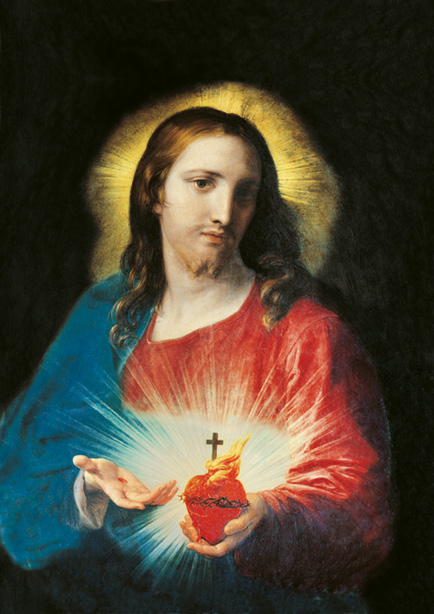
The secret to the image’s success lies in its ability to capture the essence of the mystery of Jesus’ love for humanity: a love so immense that it led to the incarnation and sacrifice of the Son of God for humanity. The Evangelist John sums up this concept by saying: “God so loved the world that he gave his only Son, so that whoever believes in him should not perish but have eternal life.” Jesus is depicted wearing a red tunic, symbolizing blood and humanity, and a blue mantle, the color of heaven and the divine. He is portrayed as young and handsome, with long hair and a face framed by a short beard.
The artistic representation
The Sacred Heart of Jesus is the true focal point of the scene, presented in the foreground with all its tangible qualities and symbolism. It represents the divinity of Jesus made man, at the center of his essence, the heart, understood as the seat of intentions and feelings, and of the capacity to feel, suffer, and love. Saint Paul writes: “Although Christ was by nature divine, he did not consider being equal to God a privilege, but emptied himself, assuming the nature of a servant and becoming like human beings; and, being found in human form, he humbled himself, becoming obedient unto death, even death on a cross.”

Around the heart, a crown of thorns evokes the one placed on Jesus’s head during the Passion, the bleeding wound recalls the spear thrust in His side, and the cross reminds us of His crucifixion. The flames at the foot of the cross symbolize God’s ardent love for humanity, a traditional attribute of Christian charity. Saint Margaret Mary Alacoque reports Jesus’s words: “My Heart is so passionately in love with humanity, and with you in particular, that, unable to contain the flames of its love any longer, it desires to spread them among humanity to enrich them with its precious treasures.”
Batoni created an image that is immediately understandable and innovative at the same time, tangibly representing the source of Christian love, embodied in the Son of God. Jesus displays the signs of the Passion on His skin, as shown by the stigmata on His hands. He is the risen Lord, not portrayed as a stern judge but as a gentle, welcoming, and loving figure. His penetrating gaze invites us not to remain indifferent. Batoni’s palette, rich in soft, luminous tones and free of dark shadows and harsh contrasts, seems to reflect Jesus’s words: “Come to me, all you who are weary and burdened, and I will give you rest. Take my yoke upon you and learn from me, for I am gentle and humble in heart.”

Invitation to reflection
Jesus seems to offer His heart, extending it forward toward you, into your own space. With the welcoming gesture of His other hand, He invites you to pause and reflect on what lies before you. This image goes beyond a simple artistic representation: it is an invitation to share emotions and feelings, to open your heart to Him and establish an authentic dialogue with Him.
The Heart of Jesus, the central figure of the scene, is a symbol of love and compassion. Depicted in the foreground, it is tangible and symbolic evidence of His having become human, down to the very core of His being. It is the seat of intentions and feelings, of the capacity to feel, suffer, and love.
The crown of thorns around the heart recalls Christ’s Passion, while the bleeding wound refers to the spear thrust in His side. The cross is a reminder of the supreme sacrifice He made for humanity. The flames at the foot of the cross symbolize God’s ardent love for humanity, a traditional attribute of Christian charity.
Jesus, risen and not portrayed as an implacable judge but as a gentle and loving figure, looks at you and speaks to your heart. This painting invites you not to remain indifferent, but to seek strength and comfort in dialogue with Him. As Saint Paul writes: “Come to me, all you who are weary and burdened, and I will give you rest. Learn from me, for I am gentle and humble in heart.”
Thank you for your attention and for sharing this moment of contemplation.


