




The collaboration between Father Alessio Fucile, an art expert, and the Shalom blog continues. Father Alessio will guide us in exploring the most important moments of the liturgical year through beautiful works of art that, in addition to inspiring wonder at their splendor, can help us better understand Sacred Scripture and the message of Jesus.
Today Father Alessio presents Giovanni Battista Tiepolo’s painting “Immaculate Conception” in preparation for the solemnity of the Immaculate Conception of the Virgin Mary, celebrated on Friday, December 8.
Today I am pleased to present a work by the Venetian painter Giovanni Battista Tiepolo. It is the painting “Immaculate Conception,” which is housed in the Prado Museum and was commissioned by the king of Spain for the church of Saint Paschal Baylon in Aranjuez.
Eve’s sin
The work is rich in details drawn from the Book of Genesis. After Adam and Eve’s sin, when they were seduced by the serpent, a symbol of the devil, God addresses the latter and says: “Because you have done this, cursed are you above all livestock… I will put enmity between you and the woman, and between your offspring and hers; he will strike your head, and you will strike his heel” (Gen 3:14-15). A severe sentence that also involves humanity. It is not a punishment but an acknowledgment of harm that entails consequences. It is not an offended God who punishes evil, but a grieving God who, despite himself, must show humanity the bitter consequences of its choices.

Our sin
Sin is nothing other than missing the mark, a wasted opportunity. A beautiful life means aiming at the target, the goal for which I was created, even though I may often miss it because of my fragility and weakness. This requires vigilance in order to build up rather than squander. I am aware of my weakness, of the evil around me, of the possibility of making the people I love suffer, and of wasting the wonderful opportunities God offers me every day. There are things I will have to say no to, even when it is difficult. In reality, the more I say no to them, the easier it will become. Life is too beautiful to waste on fleeting and deceptive illusions. Sin is not a celebration of freedom but of slavery.
The Immaculate
Ask for help from the One whom Tiepolo painted so masterfully, standing firmly on the crescent moon, a symbol of the instability of evil. The work is rich in details drawn from the Book of Genesis and Revelation. They illustrate the mystery of the Immaculate Conception, that is, the fact that Mary was preserved from original sin from the moment of her conception. Let us look together at some of these symbols and their meaning.
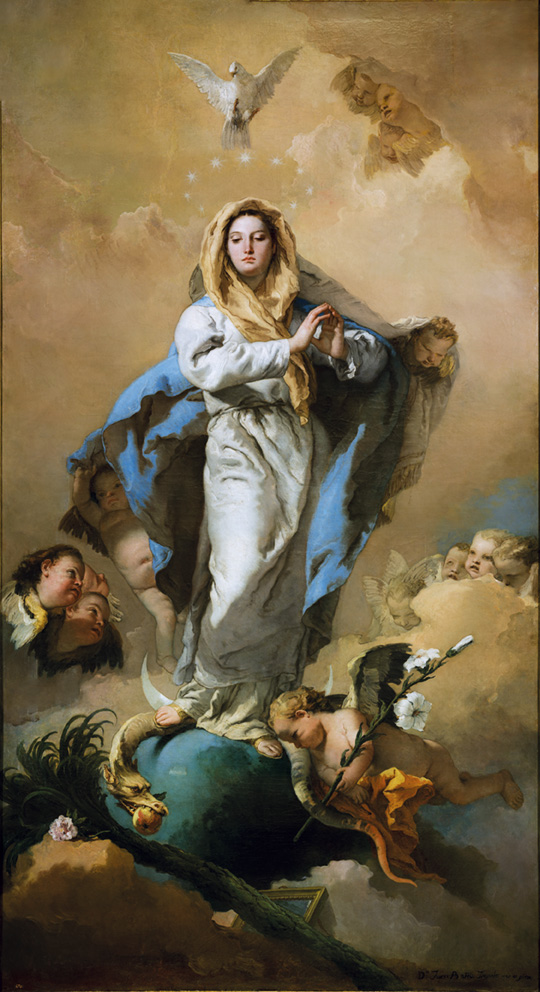
by Giovanni Battista Tiepolo
- The dove flying above the Madonna’s head symbolizes the Holy Spirit who descended upon her.
- The lilies and the rose are typical symbols of Mary: they represent her purity and passion, her love for humanity, her children.
- The serpent with the fruit of the tree of the knowledge of good and evil between its jaws refers to the sin of Adam and Eve, seduced by the devil, which brought about the rupture between God and humanity. Yet God promised them salvation through the woman’s offspring, who would crush the serpent’s head (Gen 3:14-15). This woman is Mary, who through her yes to God made possible the coming of the Savior, Jesus Christ.
- The globe symbolizes the world above which a decisive battle between the Woman and the serpent is symbolically being waged. This scene is drawn from the Book of Revelation, which describes the vision of a woman clothed with the sun, with the moon under her feet and a crown of twelve stars on her head, giving birth to a son destined to rule the nations, while an enormous red dragon tries to devour him (Rev 12:1-6). This woman represents both Mary, the mother of Jesus, and the Church, which continues its mission in the world.
- The Virgin’s silver garment, suffused with light, emerges from the shadow of the mantle, illustrating the image of the woman clothed with the sun. The crescent moon is placed beneath her feet, while the twelve stars form a crown around her head. The moon symbolizes the instability of evil, while the stars symbolize the apostles, of whom Mary is the spiritual mother and model of faith. The crown of stars is also a recognition of her royalty and victory over evil.
- The obelisk to Mary’s right shines with sunlight and alludes to traditional symbols of the Immaculate Conception, such as the “tower of David” and the “ivory tower.” These symbols evoke Mary’s invulnerability and purity, as she preserved her virginity and grace intact.
- The palm branch and mirror at her feet represent Mary’s victory and beauty, while the mirror is another reference to her purity, as well as to prudence. In fact, the mirror is a classical attribute of the virtue of Prudence, which consists in knowing how to discern good from evil and act accordingly. To avoid making mistakes, we need experience, which makes us look to the past to learn from our own mistakes and those of others. Only after burning myself with fire will I know that, in order not to burn myself again, I must no longer touch it. Past experience thus becomes a teacher of life.
- Mary wears a belt that may allude to the cord worn by Saint Francis of Assisi, a symbol of a life that needs limits and boundaries in order to express itself fully. The Franciscan cord is also a sign of poverty, humility, and penance, virtues that characterize the life of Mary and all her spiritual children.
Tiepolo’s Immaculate Conception invites us to contemplate the wonders God has worked in Mary, who was chosen to be the mother of his Son and the mother of all humanity. Each of us is a unique and unrepeatable being, loved freely for who we are!


