




The collaboration between Father Alessio Fucile, an art expert, and the Shalom blog continues. Father Alessio will guide us in exploring the most important moments of the liturgical year through beautiful works of art that, besides inspiring wonder in us through their splendor, can help us better understand the Holy Scriptures and the message of Jesus.
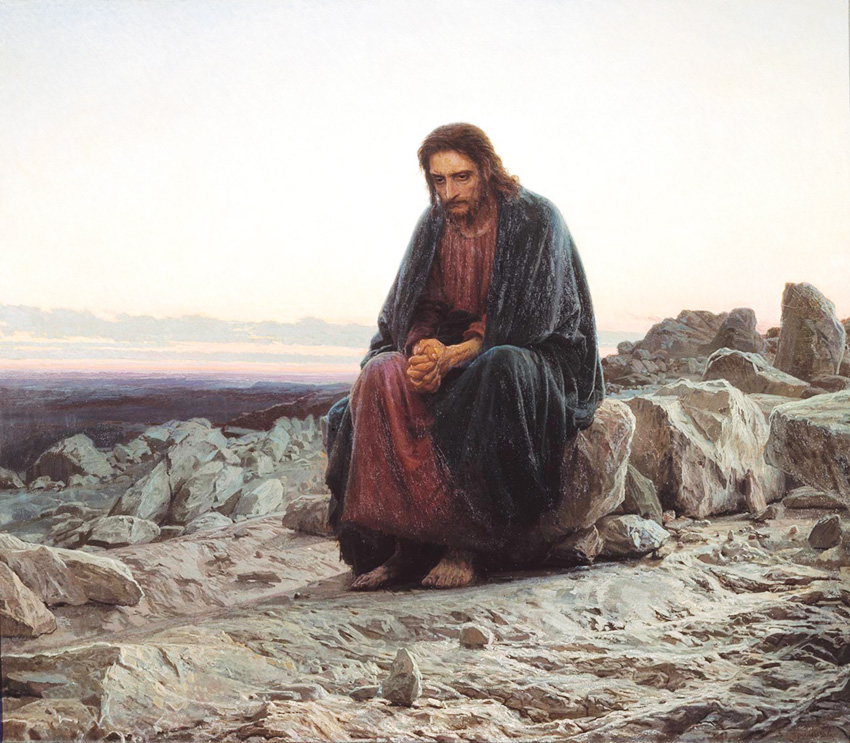
Today, Father Alessio presents “Christ in the Desert,” which can be admired at the Tretyakov Gallery in Moscow, a scene that the evangelist Mark recounts in tomorrow’s Gospel.

Who was Kramskoy?
Ivan Nikolaevich Kramskoy was one of the most important Russian painters of the 19th century. He founded a group of anti-academic realist painters known as the Itinerants, whose aim was to democratize art and spread it throughout the countryside. Kramskoy was a great portraitist, especially because he succeeded in exploring the deep and dark psychological recesses of his subjects.
“Christ in the Desert,” Kramskoy’s masterpiece
His celebrated masterpiece, “Christ in the Desert,” represents one of the high points of all Russian art. The painting has a precise aim: to humanize the figure of Jesus. His red garment indicates his human nature, while the blue cloak indicates his divine nature. Jesus is therefore human and, as such, he suffers. His face is one of the most successful artistic icons of pain and fatigue. Deep, long wrinkles furrow his face and reveal his anguished thoughts. Sitting on a rock, immersed in an arid, desolate, barren landscape, he stares into the void and tightly clenches his hands, a sign of his struggle and strength of will. There is no action, but the life of the spirit and the power of thought are visible.
The temptations of Jesus in the desert
Jesus is at the limit of his strength and must draw on his remaining physical and mental energy to endure the fasting and the temptations. His feet are wounded. The Gospel text says: “After fasting for forty days and forty nights, he was hungry at last” (Mt 4:2). In this extreme situation, after a terrifying fast, “the tempter approached him and said, ‘If you are the Son of God, tell these stones to become bread’” (Mt 4:3).
This is the temptation in which everything must satisfy me, and my appetites become the law. The situation of people enslaved and dependent on their insatiable appetites is sad. Everything must become gratifying. Destined for growing dissatisfaction and frustration because things do not exist to serve our needs but are what they are, we cannot violate the reality of things. Jesus replies: “Man shall not live by bread alone, but by every word that comes from the mouth of God” (Mt 4:4). It is interesting that Jesus does not oppose hunger with fasting, but with better food. We do not live by bread alone; that is, there is something more fulfilling: God the Father, who speaks and enters into a relationship with me. This gives life its flavor; it is what we truly need to fulfill ourselves.
He rejected the devil’s flattering proposals, but what a price he paid! He seems still to hear Satan’s enticing words echoing in his cracked ears, their skin peeled by the sun. His tormented face, deformed by suffering, betrays a devastating inner struggle that is still underway. Christ is a man and, as such, cannot remain indifferent to such temptations. His rejection reveals the priorities that guide him.

Our temptations today
Those who remain faithful to their priorities have an identity and know how to say no. Otherwise, they risk living in fragments, scattered. Obedience to priorities is woven from ordered actions that arise from fixed points, eliminate wasted time, and leave room for what is truly needed. Some priorities must be embraced at any cost. Place yourself in God’s presence, as Jesus did in the desert, and ask him what should come first in your life; as for the rest, calmly let it go.
Look at the Christ in the painting: as a man, he too must face trials, loneliness, the fear of not making it, and the temptation to flee and give up. Yet his face embodies the image of inner strength and teaches you to face the difficult situations of everyday life. After further attempts by the devil, Jesus replies: “Go away, Satan! For it is written: ‘You shall worship the Lord your God and serve him alone’” (Mt 4:10). Only your creator, only your heavenly Father, deserves your intimacy. The word worship comes from the Greek and means to bring to the mouth, to kiss. Trust in him, bow down to him, and never to anything else. He alone knows you intimately because he made you and knows what lies deep within your heart.
One final note: in the background, we can see the dawn of a new day. Jesus’ victory over temptation is a guarantee of ours. He fought and won so that we too might win.


