




The collaboration between Don Alessio Fucile, an art expert, and the Shalom blog continues. Don Alessio will guide us in exploring the most important moments of the liturgical year through beautiful works of art that, besides inspiring wonder at their splendor, can help us better understand Sacred Scripture and Jesus’ message.
Don Alessio presents today “The Healing of the Leper,” a mosaic in Monreale Cathedral, depicting the episode that the evangelist Mark recounts in tomorrow’s Gospel.
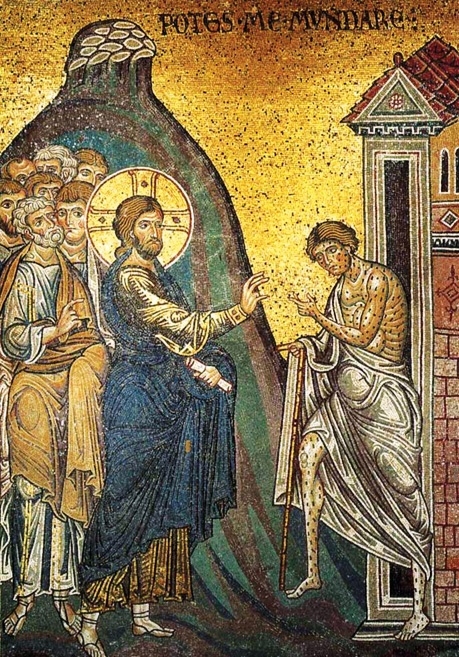
Today I present to you “The Healing of the Leper,” a mosaic in Monreale Cathedral. The mosaic is part of the cycle depicting the life of Christ, located on the right wall of the transept, and was created in the 13th century using the chromolithography technique.
Jesus’ compassion for the leper
On the right, a man covered with leprosy approaches Jesus. The episode shows a vital need and the desire expressed in the plea: “If you are willing, you can make me clean” (Mk 1:40). In response to the leper’s request, the Gospel emphasizes Jesus’ emotional involvement: “he had compassion on him” (Mk 1:41).. Compassion etymologically indicates an inner movement of a person, perceived right down to the entrails, which refer back to the maternal womb. The emotion felt by Jesus points to his “maternal” concern for people and their fragility. The Gospel repeatedly emphasizes Jesus’ emotion, especially in the face of the evil that often affects people. The prophet Isaiah, who lived centuries before Jesus, had already grasped this maternal aspect of God’s love for humanity, to the point of writing: “Can a woman forget her nursing child, and not feel compassion for the child of her womb? Even if these women forgot, I will never forget you” (Is 49:15).

Jesus’ love for each one of us
Jesus has a cruciform halo because he is a person of the Trinity, and he is followed by the group of apostles. He holds a scroll in his hand, the price of our sin, which he took upon himself to pay through the offering of his life.
The Gospel tells us that Jesus not only does not stop the leper’s gesture but even touches him. The gesture of blessing expresses this well. Your right to draw near to Jesus does not come from being righteous and worthy, beautiful and good.
Precisely because you are unjust, wounded, and sinful, you have the right to go to Him. This is the “gospel,” the good news: God loves you regardless; your misery is not an obstacle. He is not the law that judges or the conscience that condemns: He is the Father who gives life and loves you more than himself, unconditionally, just as you are. Your evil, your feeling inadequate, drives Him toward you with a love that has no measure other than your need. Jesus, which means God saves, is close to you through his touch. Your limitations, your evil, are where we come into contact with Him. In the abyss of your misery, you are touched by his infinite mercy!
Let me share a sentence from Pope Francis: «Jesus is all love. Each of us is the lost sheep, the child who has squandered his freedom by following false idols, mirages of happiness, and loses everything. But God does not forget us; he never abandons us». Thank you for your attention!
And you, have you ever experienced in your life that God never forgets you? Tell us about it in the comments!


