




The collaboration between Father Alessio Fucile, an art expert, and the Shalom blog continues. Father Alessio will guide us in exploring the most important moments of the liturgical year through beautiful works of art which, in addition to inspiring wonder at their splendor, can help us better understand the Holy Scriptures and Jesus' message.
Today, Father Alessio presents Federico Barocci's painting “The Nativity” in preparation for Holy Christmas.
Federico Barocci was a great Mannerist artist, known for his skill in creating warm and harmonious color effects. Many of his works depict religious scenes, the fruit of sincere faith. Among them, the Nativity, preserved at the Prado Museum in Madrid, stands out.
The work, created around 1590, shows us the birth of Jesus in a nighttime setting of extraordinary beauty, thanks to its poetic and mystical atmosphere. The light illuminating the entire stable, which comes from the Child's head, recalls the Gospel verse: «The true light came into the world, the light that enlightens everyone» (Jn 1:9).
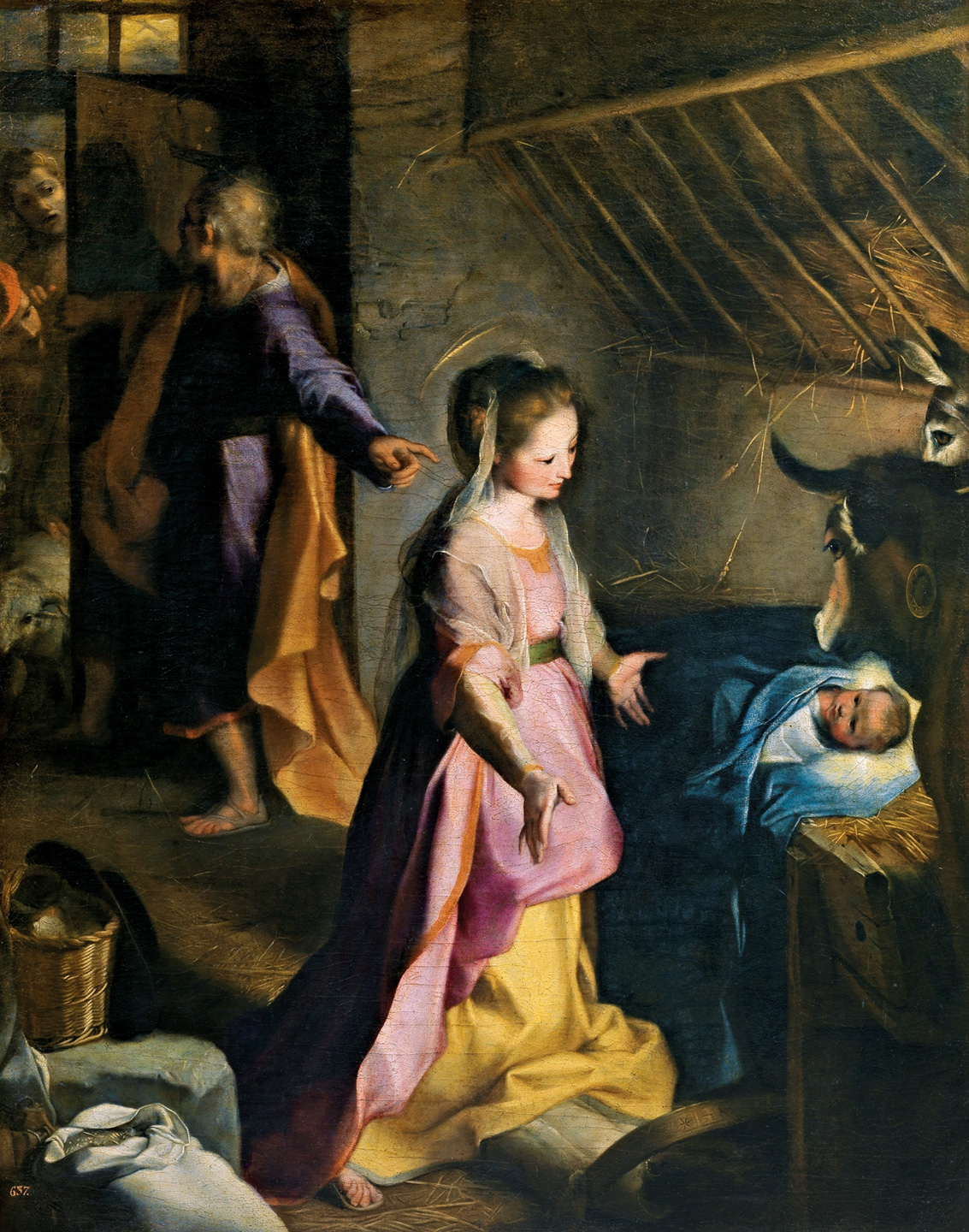
The light is reflected on Mary's blue mantle, which envelops the Child in a gesture of humble welcome. Mary is the symbol of humanity allowing itself to be embraced by God, who makes himself small and weak out of love for us.
In the stable, we see the ox and the donkey, who recognize their creator and offer him their warmth. Their presence reminds us that Jesus came for all peoples, to give them life in abundance (Jn 10:10).
Mary «gave birth to her son, wrapped him in swaddling clothes, and laid him in the manger» (Lk 2:7). Luke presents Mary as a strong and diligent mother who knows how to face difficulties with courage. The swaddling clothes are a sign of the love of Mary and Joseph, who tenderly care for the child. Jesus is truly a beloved son, who lives thanks to the affection of his parents. God needs our love and asks us to guard him.

Jesus lies on the straw in the manger and offers himself as our food. «Take and eat; this is my body, which is given for you» (Mt 26,26). At the bottom, we see a sack containing bread, foreshadowing the mystery of the Eucharist. Beside it is a basket of fruit, which speaks to us of the simplicity and poverty of the place.

Mary, illuminated by a diagonal light, kneels and contemplates her little one, looking at him with affection. Jesus returns her gaze, and a profound intimacy is established between the two. Mary adores and contemplates the newborn Jesus, the God who becomes a child. According to the norms of the Counter-Reformation, Mary adores and contemplates the newborn Jesus, the God who becomes a child.
Mary’s arms are open, symbolizing welcome; in this gesture lies all the tenderness exchanged between the mother’s gaze and that of the little child.

Joseph welcomes the shepherds and invites them to see the child. The shepherds are on the threshold, and they must make a choice: to believe or not that this child is the Savior of the world. Beyond the door, there are some sheep, which are the shepherds’ gifts. They are poor but sincere gifts.
Barocci painted this work in keeping with the trends of Counter-Reformation art: no superfluous decorations, but simple compositions, bare interiors, emotional light that highlights feelings, and clear, direct images that communicate the message to the public.
The work helps us discover the face of a child God, a poor God, a weak God, a God who renounces his greatness to draw near to us, to tell us that we are not alone. A God who loves us and makes himself small to help us respond to his love. Thank you for your attention.


