




The collaboration between Father Alessio Fucile, an art expert, and the Shalom blog continues. Father Alessio will guide us in exploring the most important moments of the liturgical year through beautiful works of art that, besides inspiring wonder in us through their splendor, can help us better understand Sacred Scripture and Jesus’ message.
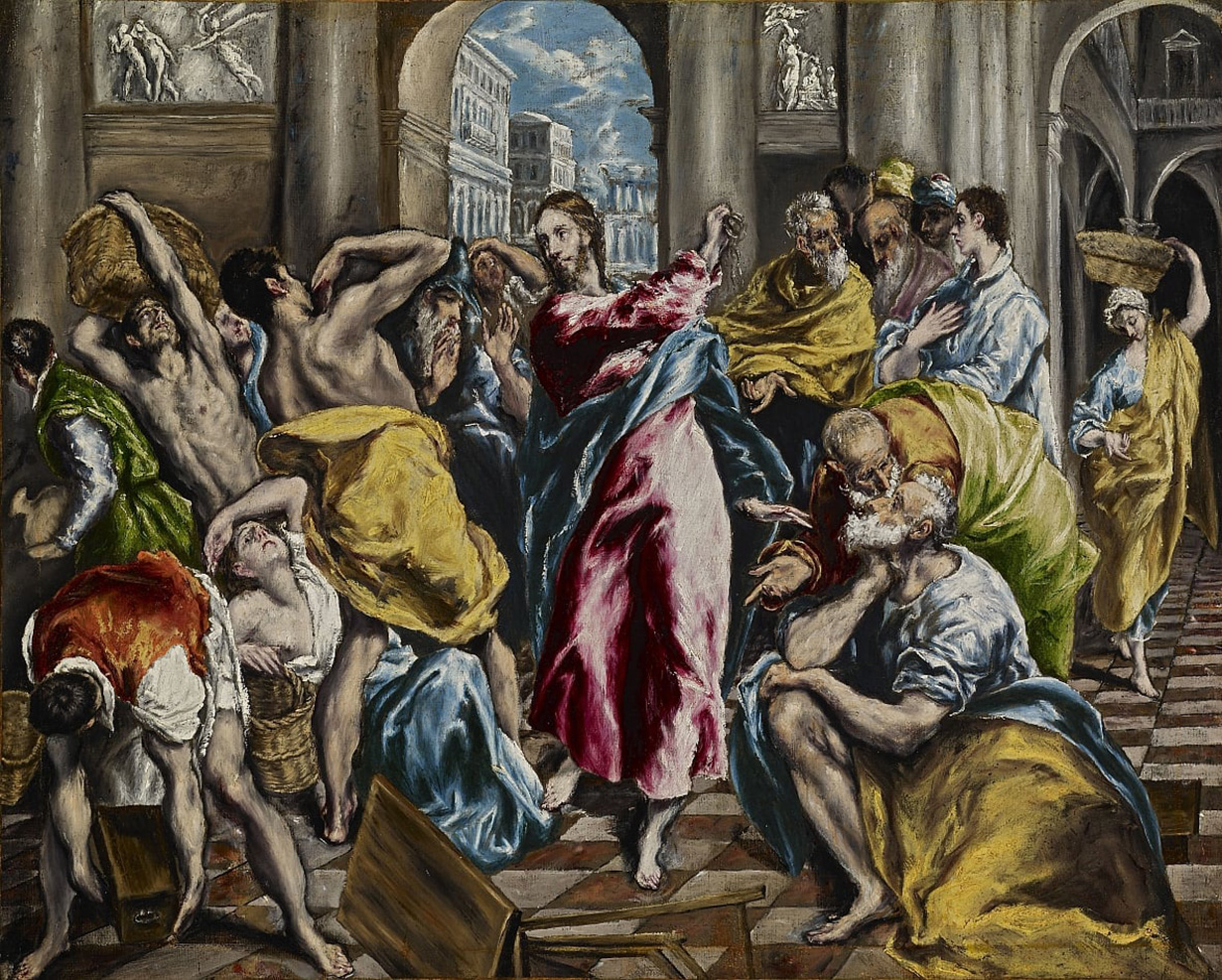
Today, Father Alessio presents “The Purification of the Temple” by El Greco, which can be admired at the National Gallery Museum in London, an episode that the evangelist John recounts in tomorrow’s Gospel.

A work by El Greco
Welcome. Today I’m showing you “The Purification of the Temple,” a work by El Greco from around 1660, displayed at the National Gallery Museum in London.
The historical and religious context
The temple, a sacred place of encounter with God, often turns into a marketplace. This happened especially during the Passover season, when many pilgrims flocked to Jerusalem and business flourished. The animals being sold were intended for offerings and ritual sacrifices; the money changers, on the other hand, exchanged the coins of the Roman Empire for others made of pure silver and gold, acceptable in the temple, where coins bearing the image of the Roman rulers could not be used. But these activities, which were meant to facilitate worship, had become an opportunity for profit. The priestly class took advantage of them to enrich itself and thus went from serving the temple to dominating it and those who frequented it. A good reality becomes corrupt when it is used as a means of power. Even the best religion can then degenerate into the worst. This is what happens with every wrong answer to a true question.
The artistic interpretation
The artist created a chaotic space with contrasting lines and unreal light, helping to convey an atmosphere of anger and turmoil. The episode deeply affected both the crowd and the disciples. The Gospel of John recounts the event as follows: “He found in the temple those who were selling oxen, sheep, and doves, and the money changers seated there. So he made a whip of cords and drove them all out of the temple, along with the sheep and the oxen.” Jesus, at the center with a whip, drives the animal sellers and money changers out of the temple’s outer portico; they can be seen on the left.

On the right, the group of apostles watches their Master’s action in amazement. Jesus, wearing a red tunic, symbolizing his humanity, and a blue cloak, symbolizing his divinity, has a serene expression and walks decisively among the ruined stalls, certain that he is carrying out God’s will.
In the background, two bas-reliefs adorn the walls of the temple. Aligned with the merchants, there is the expulsion of Adam and Eve from the earthly Paradise, a symbol of those who will be excluded from the Kingdom. On the apostles’ side, however, there is the bas-relief depicting the sacrifice of Isaac, which foreshadows the self-giving that Jesus will make to save humanity.

Among the apostles, a woman stands out. She is Mary, the mother of Jesus, who together with the apostles represents the Church, placed close to her Lord. He is the Temple of the New Covenant, in which salvation is found! Behind the apostles, in the background, are several people dressed in ecclesiastical garments contemporary to the painter. They are a historical reference to the church of the time, which El Greco invites to purification.
The Message of Jesus
Having performed this act, Jesus turns to the crowd and says: “Do not make my Father’s house a marketplace.” He invites you to move from a formal, empty religiosity to a true faith that involves you in a personal encounter with God and drives you to a life committed to justice and honesty. Formal religiosity leaves you in mediocrity. True faith has the power to change you, challenge you, help you grow, let you experience the beauty of a full and fulfilling life, rather than substitutes that do not satisfy your essential needs. Thank you for your attention.


