




The collaboration between Don Alessio Fucile, an art expert, and the Shalom blog continues. Don Alessio will guide us in exploring the most important moments of the liturgical year through beautiful works of art that, in addition to inspiring wonder at their splendor, can help us better understand the Holy Scriptures and Jesus' message.
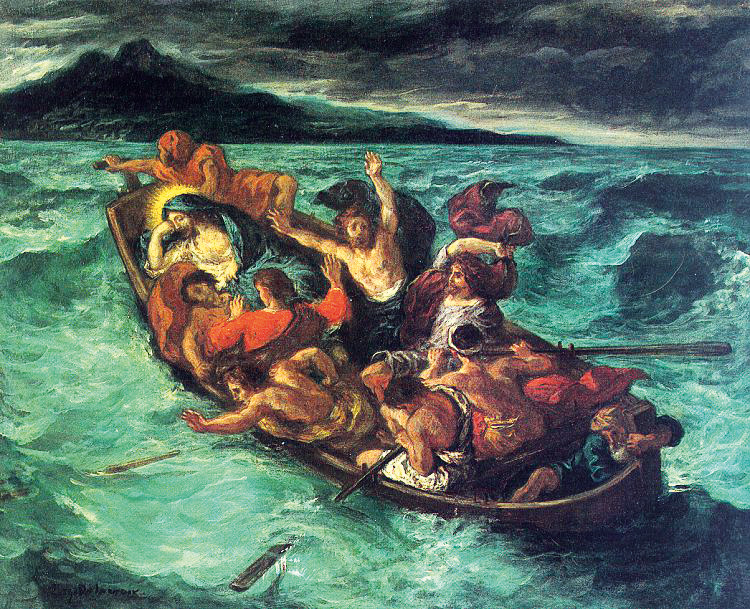
Today, Don Alessio presents “The Calming of the Storm” by Eugène Delacroix, a work from 1841 that is currently housed at the Museum of Art in Kansas City.
Characters and Symbolism
This canvas represents one of the most significant interpretations of the episode recounted in the Gospel according to Mark. The storm causes great agitation among the boat's passengers. At the top, a man, looking to the left, tries to keep control of the helm. Jesus, asleep and wrapped in a broad white cloth, supports his head with his hand. Beneath him, a figure on the left, leaning against the boat, watches the sea with concern, his neck twisted unnaturally. The figure seen from behind is Mary Magdalene, the only one looking toward Jesus. She raises her arms in a gesture that seems to say: “Friends, let us trust; He is here with us!” Delacroix's intuition to include this woman in the scene, although she is not mentioned in the Gospels, is original and evocative. The figure dressed in yellow, standing in the center, is overcome by panic. The features of his face are only sketched, and his hair is tousled by the wind. Beside him, a disciple dressed in pink, with his back bent backward, desperately tries to grasp the cloak that seems to be flying away. This figure symbolizes anger toward God, the cursing born of anguish. In front, another figure, with an arm extended forward, seems to be searching for something in the sea, perhaps a lost oar. He represents the nostalgia that emerges in difficult moments, the regret for better and safer times. At the bow, two seated men, focused on the effort, try to steer the boat with the oars. In the lowest part, a tenth figure, only sketched and barely distinguishable, is painted in the colors of the boat. He seems to be asleep, but in reality he is paralyzed with fear and clutches his garment to his chest like a shield, closing his eyes so as not to see. It is a typical reaction of depression, in which one enters a kind of lethargy, a paralysis.
The Boat of Life
Perhaps you too can recognize yourself in these people: lost, agitated, confused, paralyzed. That boat represents your life, your home, often at the mercy of evil which, like a dark wave, seems to overwhelm you. As Pope Francis recalled in his moving prayer during the pandemic: “We found ourselves afraid and lost. Like the disciples, we were caught off guard by an unexpected storm. We realized that we were all in the same boat, fragile and disoriented, called to row together, in need of mutual comfort. We are all on this boat, like the disciples who, in anguish, cry out: ‘We are lost,’ and we understood that we must move forward together.”
Another significant element of the scene is the great wave that, rising above the boat, seems about to engulf it. This once again calls to mind the Pope’s words: “The storm reveals our vulnerability and lays bare the false securities on which we have built our lives and our plans. The storm clearly shows us the intention to forget what has nourished the souls of our peoples; all those attempts to anesthetize ourselves with apparently ‘saving’ habits, incapable of drawing on our roots and evoking the memory of our elders, thus depriving us of the immunity necessary to face adversity. The trick of those stereotypes with which we disguised our ‘egos,’ always concerned with their own image, has fallen away; and once again, our blessed common belonging has emerged, from which we cannot withdraw: belonging as brothers.”

The reassuring presence of the Lord
As we have seen, Jesus is in the boat, highlighted by the artist with a touch of intensified light. The work evokes your fears, but it also reveals that you are not alone: you are in the company of the Lord and can turn to Him. As Pope Francis also suggested: “It is time to reset the course of life toward You, Lord, and toward others. The beginning of faith is recognizing that we are in need of salvation. We are not self-sufficient; on our own, we sink: we need the Lord as ancient sailors needed the stars. Let us invite Jesus into the boats of our lives. Let us entrust our fears to Him. Like the disciples, we will discover that, with Him on board, we do not suffer shipwreck. For this is the power of God: to transform everything that happens to us into good, even the bad things. He brings serenity to our storms, because with God life never dies.” Thank you for your attention.


