




The collaboration between Don Alessio Fucile, an art expert, and the Shalom blog continues. Don Alessio will guide us in exploring the most important moments of the liturgical year through beautiful works of art that, in addition to inspiring wonder at their splendor, can help us better understand the Sacred Scriptures and Jesus’ message.
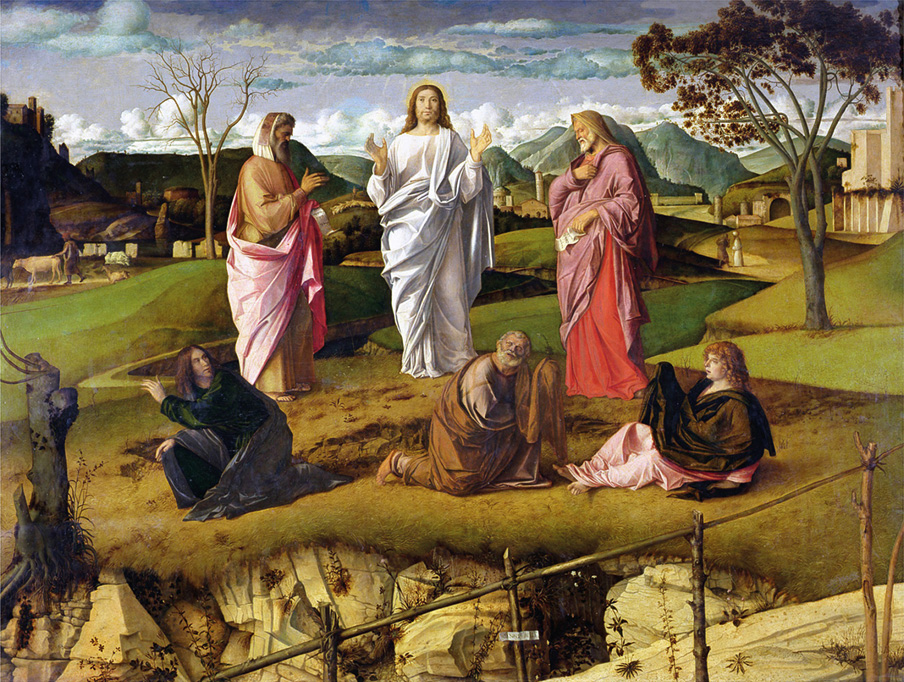
Don Alessio presents today Giovanni Bellini’s “Transfiguration,” a work created between 1478-79 and now housed in the Capodimonte Museum in Naples.
Description of the work
The canvas depicts the Gospel episode in which Christ, on a mountain traditionally identified as Tabor, is transfigured before three apostles, revealing his divine nature. In the geography of Palestine, “the high mountain” (Mk 9:2) mentioned in the Gospel is not even a hill, but indicates a symbolic reality: human beings are called to climb the mountain, that is, to transcend themselves, to go beyond themselves and their stature. We are all small, but by climbing the mountain we become great! From time immemorial, in every religious tradition, human beings have felt the need to climb the mountain to draw closer to God.
Details of the composition
The painting, signed on the sign hanging from the fence, depicts Jesus at the center with his hands open in an attitude of prayer, wearing white robes and with a luminous face, as described in the Gospels. The prophets Elijah and Moses, holding scrolls written in Hebrew, stand to his right and left and bear witness to the fulfillment of the Scriptures in Christ, represented in terms of growth: Bellini places a bare tree on the left and a tree full of leaves on the right. At their feet are three apostles: James on the left, Peter in the center, and John, the youngest, all depicted with faces expressing fear. “They fell with their faces to the ground and were overcome with great fear” (Mt 17:6); this happens after the manifestation of God the Father: “And behold, a voice said: ‘This is my beloved Son, with whom I am well pleased. Listen to him’” (Mt 17:5). Bellini cannot represent that voice, but it nevertheless seems to vibrate in the air: first of all, it can be perceived in the apostles’ gestures, but even more so in the luminous face of the incarnate Word, a manifestation of the face of God the Father: “Whoever has seen me has seen the Father” (Jn 14:9). The Father’s voice is also made present in the cloud, described by the Gospel as luminous and enveloping: Bellini depicts a sky in which the clouds gather and appear luminous on the horizon as if directly illuminated, while the main scene seems truly shadowed by the presence of a large cloud: “A bright cloud overshadowed them” (Mt 17:5).
Symbolism and landscape
Bellini places the figures, clearly highlighted by their rich drapery and harmonious symmetry, on a large elevated rock, far from the landscape behind them and, above all, separated from the viewer by a chasm. The rough, jagged rocks of the steep ravine recall the influence of Andrea Mantegna, Giovanni Bellini's brother-in-law. Beside Jesus on the left, in the landscape among the hills, the Venetian artist paints a flock of sheep, a clear allusion to the good shepherd who guides and protects them. A city is depicted on the right, while on the left there are a castle and a shepherd with cattle grazing.
Background details
In the background, two buildings can be seen depicting the Mausoleum of Theodoric and the bell tower of the Basilica of Sant'Apollinare in Classe in Ravenna, while farther to the right, also in the background, there are two human figures, one of whom is depicted wearing a white turban: they are conversing and seem unaware of the divine event taking place.

Symbolism of the broken tree trunk
In the foreground on the left is a broken tree trunk with a shoot sprouting from it, an allusion to Jesus's violent death and subsequent resurrection.
To conclude, the famous Gospel episode of the Transfiguration teaches, among other things, to have eyes capable of seeing beyond what is visible: everyone sees the visible, but we must grasp the invisible, which lies beneath the shell, beneath the skin, beyond the obvious, beyond what happened, beyond the event. This is the Transfiguration: it is not yet a full vision - we will have that at the end of life - but now we have the opportunity to catch a glimpse.
Thank you for your attention.


