



The collaboration between Father Alessio Fucile, an art expert, and the Shalom blog continues. Father Alessio will guide us in exploring the most important moments of the liturgical year through beautiful works of art that, in addition to inspiring wonder at their splendor, can help us better understand Sacred Scripture and the message of Jesus.
Today, Father Alessio presents Masaccio’s fresco “The Trinity,” which can be admired in the Basilica of Santa Maria Novella in Florence.

Masaccio, a genius of the Renaissance who died prematurely at the age of 27, left us his final and extraordinary work: “The Trinity,” created around 1426. This fresco, located on a wall of the Basilica of Santa Maria Novella in Florence, represents the dogma of the Trinity through human elements, revealing the divine mystery through the suffering of Jesus.
The painting is a manifesto of Renaissance principles, so much so that looking at it gives the impression of standing before an opening that extends beyond the church’s physical space. Man, the measure of creation, moves within a real and measurable context. The spatial relationships between human figures and architecture are accurate and credible, a triumph of perspective.
The scene is set inside a structure reminiscent of Roman triumphal arches, with their coffered vault, Ionic columns, and barrel vault. For Masaccio’s contemporaries, the work was an absolute novelty, since for the first time the traditional gold or sky-blue background was abandoned in favor of a realistic architectural space.
At the center of the perspective composition we find Jesus, a point of reference for every person searching for meaning and their place in the world. God the Father, depicted as a mature, barefoot man, stands on a platform, supporting the wood of the cross. His halo, seen in foreshortening, symbolizes divine radiance. With his arms outstretched, God the Father seems to offer his Son for the salvation of humanity, as the evangelist John reminds us: “God so loved the world that he gave his only begotten Son.”
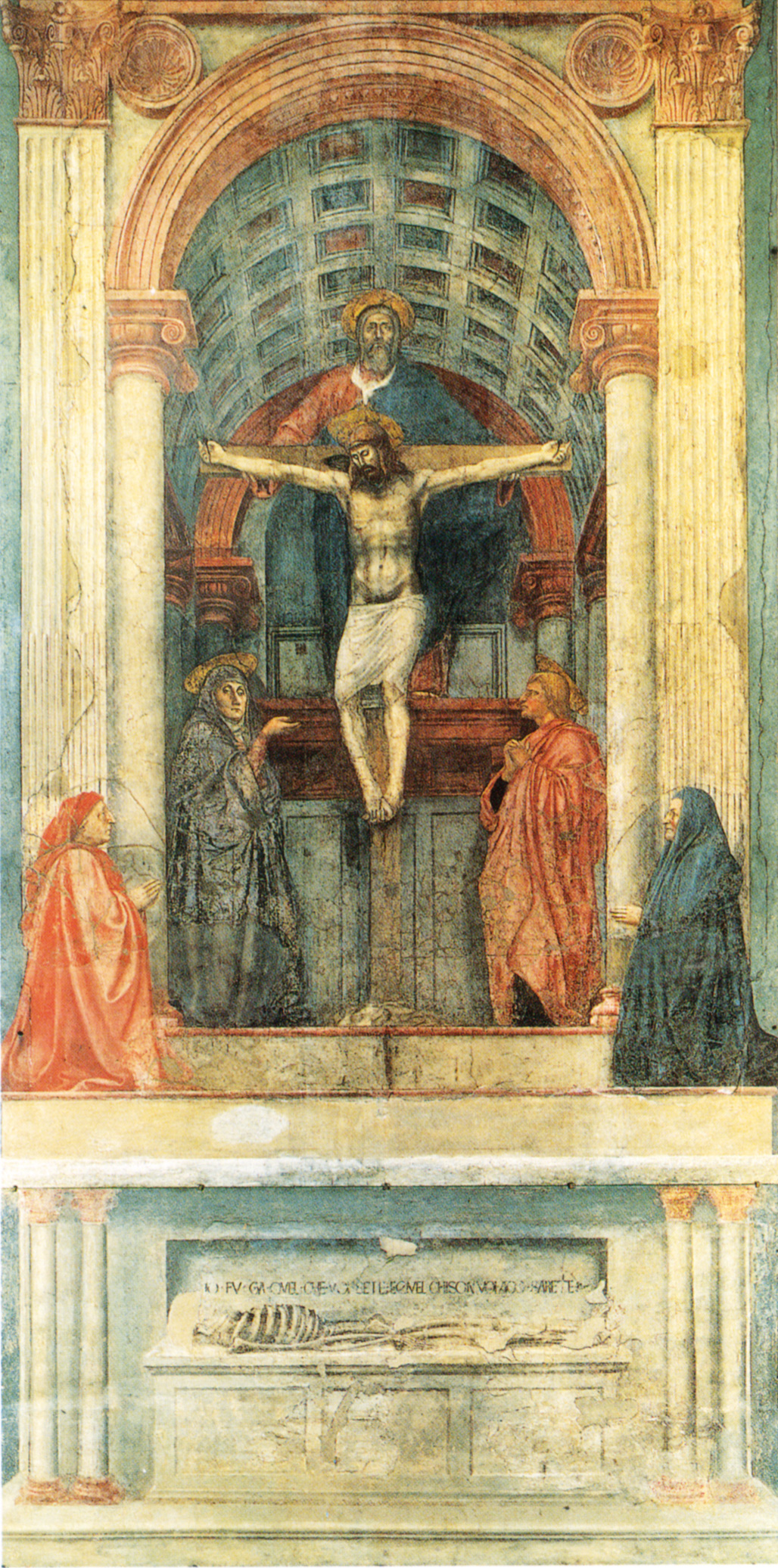
The gesture of God the Father also reveals the profound intimacy that binds him to Jesus, sharing in his suffering through an unbreakable bond. Father and Son are the same height and are the only ones not subject to the rules of perspective, symbolizing the Divine and eternity, beyond the laws of time and space. Some have interpreted the position of God the Father as a reference to the figure of the priest who, during Mass, raises the Eucharist.
Among the divine figures, the dove represents the Holy Spirit, completing the representation of the Trinity and emphasizing the sacredness of the entire composition.
At the crucial moment when Jesus “bowed his head and gave up his spirit”, that Holy Spirit promised by Him himself, manifests as an eternal gift to the disciples. This event is symbolically represented in Masaccio’s fresco, where the presence of the Holy Spirit is palpable and promised for eternity.
Beside the cross, Mary stands out, looking directly at the viewer. This gaze invites deep contemplation of the event and an understanding of the immensity of the love of a God who sacrifices his own life. Opposite her, John the Evangelist symbolizes humanity, which is called to recognize Mary as a spiritual mother, a bond strengthened when Jesus entrusts his mother to the disciple.
Further down, the patrons of the work, Betto di Bartolomeo and his wife, are depicted kneeling and praying, humble witnesses to a divine event. Beneath them are an illusionistic altar and a skeleton inscribed with the words: “I was once what you are, and what I am you too will become” - a powerful memento mori that reminds us of the transience of human life and the importance of living with awareness and meaning, in view of eternity.

This skeleton also alludes to the tradition that holds that Jesus was crucified over Adam’s tomb, symbolizing through his death the redemption of the entire human race.
The figures are connected through the skillful alternating use of red and blue, and are arranged according to a triangular pattern that refers to the doctrine of the Trinity. The Cross thus becomes the meeting point between the divine and the human, the place where the Father touches our personal history and through which the Holy Spirit is promised and given, making us capable of loving with the same divine intensity.

According to Masaccio, love is not coercion but arises spontaneously in a context of freedom and trust. Faith is not merely a duty and respect for rules, but a fundamental choice to love God. This love draws us into Trinitarian life and enables us to love as He loves, thus becoming the path to salvation.
Masaccio suggests an ascending path to attain salvation: beginning with the skeleton representing mortal life, passing through the patrons who invite us to a relationship with God through prayer, and finally reaching divine life, represented by the Trinity, through the intercession of the saints, the Virgin, and Saint John.


