




The collaboration between Don Alessio Fucile, an expert in art, and the Shalom blog continues. Don Alessio will guide us in exploring the most important moments of the liturgical year through beautiful works of art that, besides inspiring wonder through their splendor, can help us better understand the Holy Scriptures and the message of Jesus.
Today, Don Alessio presents the painting “The Adoration of the Magi” by Gentile da Fabriano in preparation for the solemnity of the Epiphany of the Lord, which takes place tomorrow, January 6.
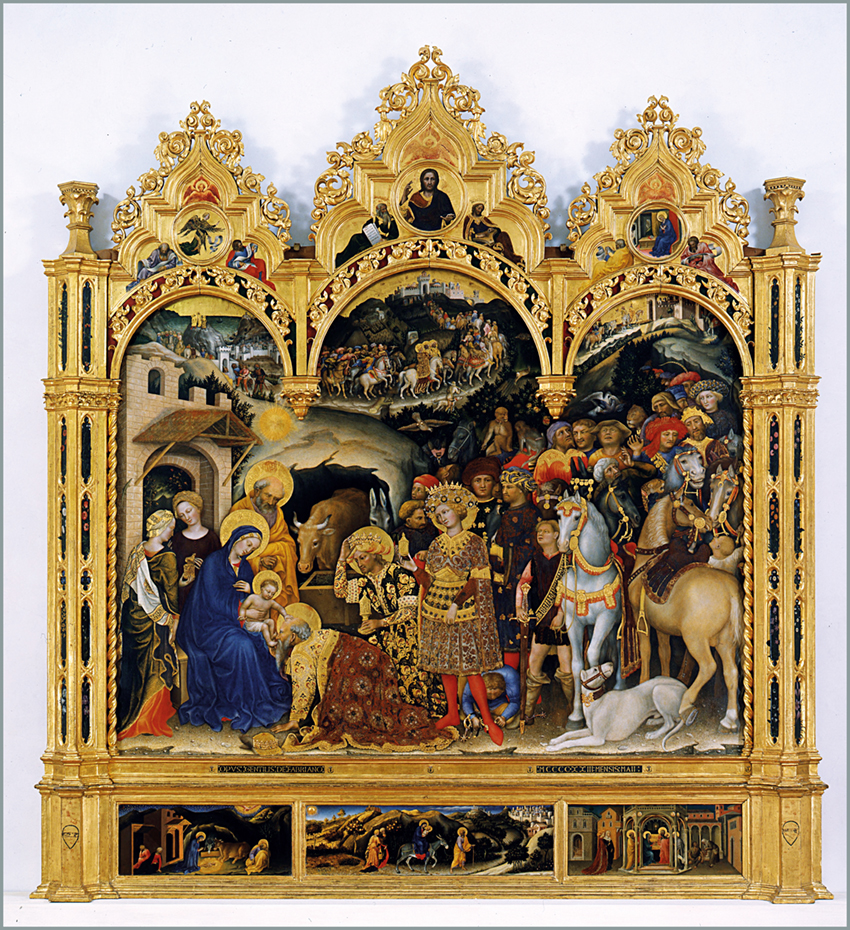
Gentile da Fabriano, considered the greatest interpreter of the International Gothic style, created The Adoration of the Magi in 1423. Considered his masterpiece, it is housed in the Uffizi Gallery in Florence. The signature is above the predella. The altarpiece was commissioned by the wealthy Palla Strozzi.
The journey of the Magi in search of Jesus
The altarpiece tells the story of the journey of the three wise men from the East. The figures overlap in a chaotic and festive manner, creating a fairytale-like whole. The narrative begins in the three lunettes: on the left, the Magi are seen viewing the comet from the top of the mountain, while below, a harbor and several caravels can be seen on the sea; in the central lunette, the procession is near Jerusalem, in an enchanted landscape of cultivated fields, where there is a fissure in the ground and a makeshift little bridge; finally, in the last lunette, the entrance into the city is shown through a drawbridge.
The journey of the Magi is a symbol of life's journey. It ends with the encounter with the one who is the dream of all dreams. What drives the Magi? Hope. Hope is a restlessness of the heart that enables people to walk toward the future. It is the secret force that makes our soul vibrate, keeps our spirits high, and urges us toward all that is great beyond ourselves. The Magi are travelers in search of something infinitely beautiful, something called Jesus. Jesus lies at the heart of all their dreams. He is the fulfillment of all their aspirations. This explains their immense joy at finding the child with Mary, his mother.

The arrival at the grotto
The procession reappears from the right and occupies the entire lower half of the painting.
On the left, the arrival at the grotto, where the comet has come to rest and where the ox and the donkey are in front of the manger. In front of the shelter of a dilapidated hut are Joseph, Mary with the Child, and two handmaids. A lizard is climbing onto the hut.
Before the Child, the three Magi kneel: the first, the elderly one, has already laid his crown on the ground and acknowledges Jesus’ royalty by prostrating himself; his gift is already in the hands of the handmaids; the second, a mature man, is about to crouch down and is removing his crown with his right hand; the third has just dismounted from his horse, and a servant is removing his spurs; he is already looking at the Child and holds a golden vessel to give as a gift. The Magi are depicted at the three stages of human life: youth, maturity, and old age, because love for Jesus must characterize every stage of life.
Their clothes are incredibly splendid. The Magi are seekers; they are not content with what they have and leave behind their palaces and their women. Everything that is enviable to us becomes, for them, as Paul will say, negligible in the face of “the goal of gaining Christ and being gained by him.”
Saint Augustine stated that we must seek the truth and, after finding it, set out again to seek it. Love is not something you take and possess. Love is a journey: every day, every morning, you must set out in search of your husband, your wife, your children, your friends, the people you love, and if you do not set out every day, you lose the love you presume to have.

The scene
At the center are two figures: the man holding the falcon is Palla Strozzi, while the person next to him, who is looking at us, is probably his son Lorenzo. There are numerous animals: horses that, frightened by a leopard, create a sense of movement; a greyhound stretching between a horse’s legs, wearing a magnificent golden collar; farther back, another leopard, a dromedary, two little monkeys, a falcon in flight, and other birds.
The star
The Magi set out when they saw a star appear. They raised their eyes toward the sky and, as they did so, realized that something new was happening in heaven and that something new was about to happen on earth: that is why they set out on their journey. You too must raise your eyes and see the stars. The star is a light, the star is a person who points toward what is good, the star is an event that turns existence upside down. Raise your eyes, look at the star! Look up! Do not grow weary, even if others make fun of you. Think of how many people must have discouraged the Magi from undertaking their journey. To look at the star, you must overcome the barrier of ridicule. Your colleagues, family members, and friends mock you; keep looking at the star.
Saint Paul says: “What no eye has ever seen, what no ear has ever heard, what no human heart has ever imagined, God has prepared for those who love him.” Christianity is a great waiting and hope in which God surpasses human longing so completely. Heaven is the fulfillment of all human hopes.
Have you ever had the courage to follow Jesus against all odds and opposition? Tell us about it in the comments!


