




The collaboration between Father Alessio Fucile, an art expert, and the Shalom blog continues. Father Alessio will guide us in exploring the most important moments of the liturgical year through beautiful works of art that, in addition to inspiring wonder at their splendor, can help us better understand Sacred Scripture and the message of Jesus.
Today, Father Alessio presents “The Annunciation” by Blessed Angelico, which can be admired at the Prado Museum in Madrid, on the occasion of the solemnity of the Annunciation of the Lord.
Hello everyone! Welcome to this new adventure discovering hidden messages in a famous work of art.
Before we immerse ourselves in the work, let me tell you about its author, Blessed Angelico. Although he was beatified only in 1982 by Pope John Paul II, he was already known as “Blessed” shortly after his death, both for the spirituality of his works and for his humanity and humility. A unique case in history: his works of art were evidence of his holiness.
Born in Vicchio in Mugello around 1395, Blessed Angelico took his vows at the convent of San Domenico in Fiesole, then a center of the Dominican Observant movement, whose members followed the original rule of Saint Dominic centered on absolute poverty and asceticism.
He died in Rome and was buried in the Dominican church of Santa Maria sopra Minerva, where we can still admire his tomb today. He was a key figure of the Renaissance, known for his mastery of perspective and his conviction that painting was an act of preaching, a way to “give Jesus to others.”
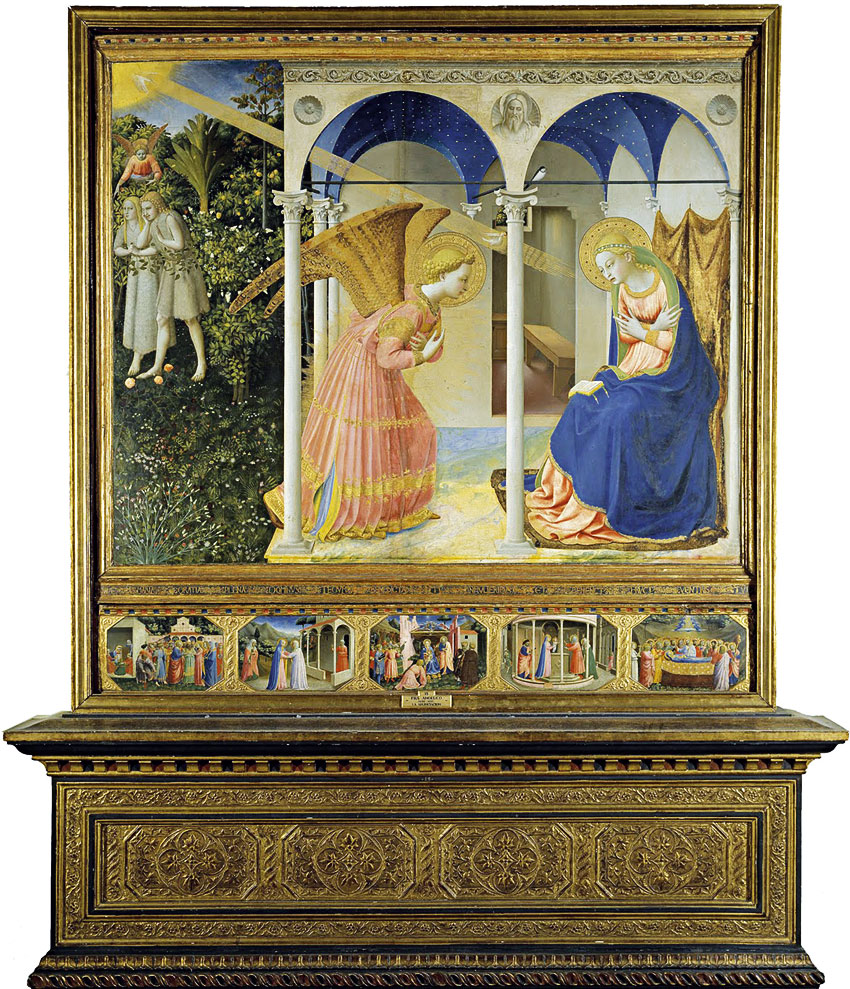
The Annunciation altarpiece
It dates back to the 1430s and is housed at the Prado Museum in Madrid. Created for the convent of San Domenico in Fiesole, it depicts the Annunciation of Mary, a fundamental event marking the beginning of life according to the Florentine culture of the time. In Florence, the beginning of the civil year was celebrated on March 25, the day of the Annunciation, a symbol of creation and the fall of man, as well as the incarnation of the Word of God.
In this mystery, the Virgin Mary embodies the people's admiration and devotion, being a model of all Christian virtues. The Annunciation by the Angel Gabriel is the first; the second will take place beneath the cross, when Jesus gives his mother to humanity.
A phrase by Mino Reitano sums up this feeling: “Pray to the Madonna unceasingly, love Her. You will see that even in difficult moments you will never feel alone.”
The altarpiece's composition is tripartite: the garden, the arch with the Angel, and the arch with the Virgin. The vanishing point, located inside the house, draws attention to the event of the Annunciation.

Adam and Eve
Angelico, in the left section, does not so much depict Adam and Eve's original sin as their punishment. The earthly paradise, the work's background, is a lush garden symbolizing Mary's virginity ("hortus conclusus"). Among the symbolic plants, the palm stands out as a prefiguration of Christ's martyrdom, along with the red roses, an allusion to the blood of the Passion.
Adam and Eve, depicted as they move away from Paradise, are flown over by an Angel who banishes them irrevocably, symbolizing human destiny but also God's loving care, as He never abandons His creatures.
Mary and the Angel Gabriel
In the upper-left corner, the glow of a golden light reveals the hands of the Eternal Father. These same hands, which once created Adam and Eve and then banished them from paradise for their sin, now send a dove, symbolizing the Holy Spirit, along a ray of light toward the Virgin Mary, Mother of the incarnate Word. The three divine Persons work together to redeem humanity from the consequences of original sin.
The Renaissance architecture of the portico, with its slender columns, recalls Michelozzo’s style and leads into Mary’s room, a place of poverty and privacy that reflects her inner peace and serenity. Beneath the portico, the star-studded azure vaults frame the two protagonists of the mystery: the Angel Gabriel and Mary. In the medallion above the central capital, the Eternal Father observes the event he orchestrated. A swallow, a universal symbol of spring, perched on the arch above Mary, announces the saving birth of Jesus.
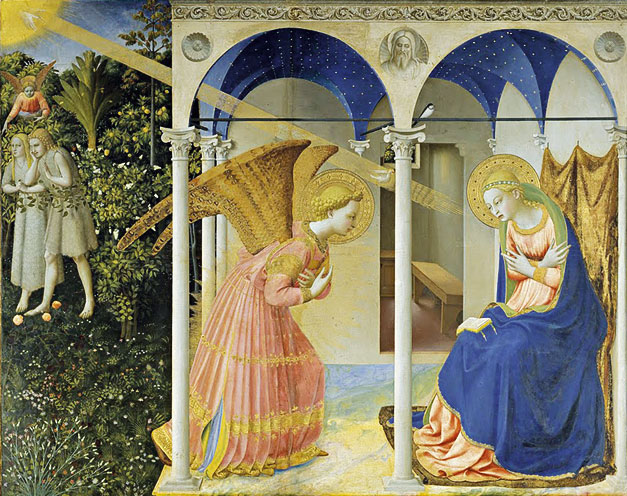
Gabriel, radiant in a pink garment embroidered with gold, appears gently in profile before the Virgin to announce the divine message. He invites her not to be afraid, because the Lord is with her, echoing passages from the Old Testament. God’s presence manifests itself as security beside man. The Angel’s hands crossed over his chest express prayer and devotion, a gesture mirrored by Mary. Both bow before the manifestation of divinity: Mary before the angelic messenger of God, and the angel before Mary’s womb, which will welcome God. “Nothing is impossible for God,” says the angel, an invitation to believe in divine possibilities beyond human limits.

Mary, seated on a seat covered with a cloth, is shown absorbed in prayer, reflecting on the Word of God. She bows humbly, accepting her role as the handmaid of the Lord, ready to do his will. The book on her lap symbolizes her devotion to listening to and meditating on the divine word. Dressed in pink, a symbol of her royal dignity, and wrapped in an azure mantle, a sign of the divine, Mary embodies the angel’s promise: the Holy Spirit will descend upon her. Her hands crossed over her chest welcome the Son into her womb, marking the beginning of a new era.
The painter connects two moments distant in time but intimately connected: the fall of man and redemption through Mary. It is noteworthy that Eve’s gaze is directed toward the Madonna, recognized as the new Eve, the one God chose to renew all things.


