




The collaboration between Don Alessio Fucile, an art expert, and the Shalom blog continues. Don Alessio will guide us in exploring the most important moments of the liturgical year through beautiful works of art that, in addition to inspiring wonder at their splendor, can help us better understand the Holy Scriptures and Jesus’s message.
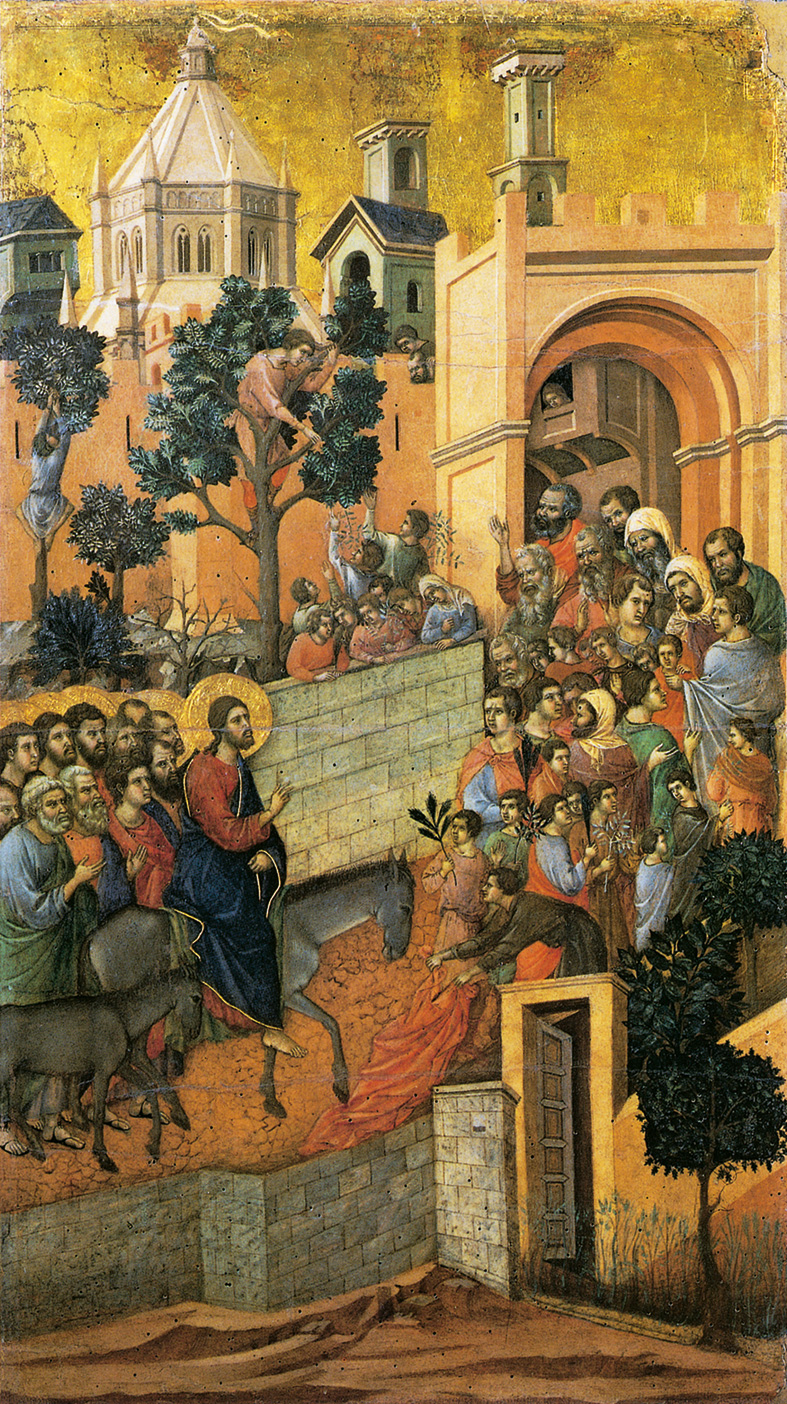
Today, Don Alessio presents Duccio da Buoninsegna’s “Entry of Jesus into Jerusalem,” which can be admired at the Museo dell’Opera del Duomo in Siena, on the occasion of Palm Sunday, which falls tomorrow.
The Master of the Sienese School
Duccio da Buoninsegna (Siena, circa 1255 – Siena, circa 1319) is recognized as the first great master of the Sienese school. His style evolved from an initial adherence to the conventions of Byzantine and Gothic art toward a more modern approach, influenced by Giotto’s example, particularly in the more accurate rendering of perspective and the figures’ volumes. His masterpiece, the Maestà of Siena Cathedral, of which the work in question is one of the panels, represents one of the greatest examples of fourteenth-century Italian art. This magnificent work of art, a true altarpiece complex, is considered the largest altarpiece ever created in the history of Italian art.

A Vivid Biblical Episode
The episode of Jesus’s entry into Jerusalem, which precedes his Passion and death, is one of the best-known events in Christ’s life and is narrated in the four canonical Gospels. Jesus’s arrival in the city is greeted enthusiastically by a joyful crowd waving palm branches and spreading cloaks and foliage on the ground as a sign of homage, acclaiming him with prophetic words: “Hosanna! Blessed is he who comes in the name of the Lord” (Mt 21:9).
Colors, symbolism and iconographic details
For this scene, Duccio used twice as much space as for the other panels devoted to the life of Christ. The vivid colors against a gold background immediately attract attention; the latter element is a legacy of the Byzantine tradition. In the work, Christ is depicted entering the city seated on a donkey, accompanied by its foal - a faithful representation of the biblical account. The crowd welcomes him joyfully; among them are the apostles, including Peter, recognizable by his white beard and hair and green cloak. There are only eleven of them, as Judas is absent, whom the artist chose not to depict. A boy can be seen cutting branches from a tree and handing them to other figures below; other children spread cloaks and wave branches as Jesus passes, as a sign of respect. Another boy is climbing a smaller tree with curious movements. From the mouths of the children and infants rises praise for this coming Messiah king, who, as the prophet sings, rides on the back of a donkey, the mount of kings in times of peace: “Rejoice greatly, daughter of Zion, shout for joy, daughter of Jerusalem! Behold, your king is coming to you. He is just and victorious, humble, riding on a donkey, on a colt, the foal of a donkey” (Zec 9:9).

Symbolism and urban context
The largest tree just above Christ’s head alludes to the cross, the destiny he himself chose for the salvation of every human being. The smaller tree that appears behind Jesus’ halo, withered and leafless, refers to the barren fig tree that Christ found without fruit (cf. Mk 11:12-14). The structure even higher up, which recalls Siena’s old Baptistery, instead points to the Temple of Jerusalem, here a symbol of Christ’s Resurrection, as recalled in the Gospel of John: “Destroy this temple! In three days I will raise it up […].” Jesus was speaking of the temple of his body” (Jn 2:19-21). The Temple, the paved road, the battlements, the loopholes in the city walls, and the other buildings within the city, painted meticulously by Duccio, evoke the Siena of his own time, a device intended to engage viewers emotionally and make them feel like active participants in the Gospel episode depicted.

Gethsemane and the Mount of Olives
The small gate in the foreground below the large city gate indicates the Garden of Gethsemane, located on the slopes of the Mount of Olives. It was toward the Mount of Olives that Christ sent the disciples to procure the donkey for him, and it was on the Mount of Olives that, four days later, he would be arrested and taken to trial (cf. Mt 21:1; Lk 22:39). The two gates - one crowded with people, the other empty, alluding to the solitude of Jesus’ hour of inner crisis - sum up the paradox of this messianic entry. The faces of the figures closest to the gate are larger than those depicted in the foreground, a device used to show differences in age and social background. It is also noteworthy that only the children truly go to meet Jesus. Some of the adults even seem to want to restrain their joyful enthusiasm. The adults in the crowd remain mostly hesitant and adopt an ambiguous attitude that already foreshadows what will happen on the day of the arrest. Indeed, these same faces, which here and now only appear to sing Hosanna to Jesus, will loudly demand his crucifixion in just a few days.


