




Today begins the collaboration between Father Alessio Fucile, an expert in art, and the Shalom blog. Father Alessio will guide us in exploring the most important moments of the liturgical year through beautiful works of art which, besides inspiring wonder at their splendor, can help us better understand Sacred Scripture and the message of Jesus.
Today Father Alessio presents Beato Angelico’s painting “The Last Judgment” in preparation for the Solemnity of Our Lord Jesus Christ, which is celebrated on Sunday.
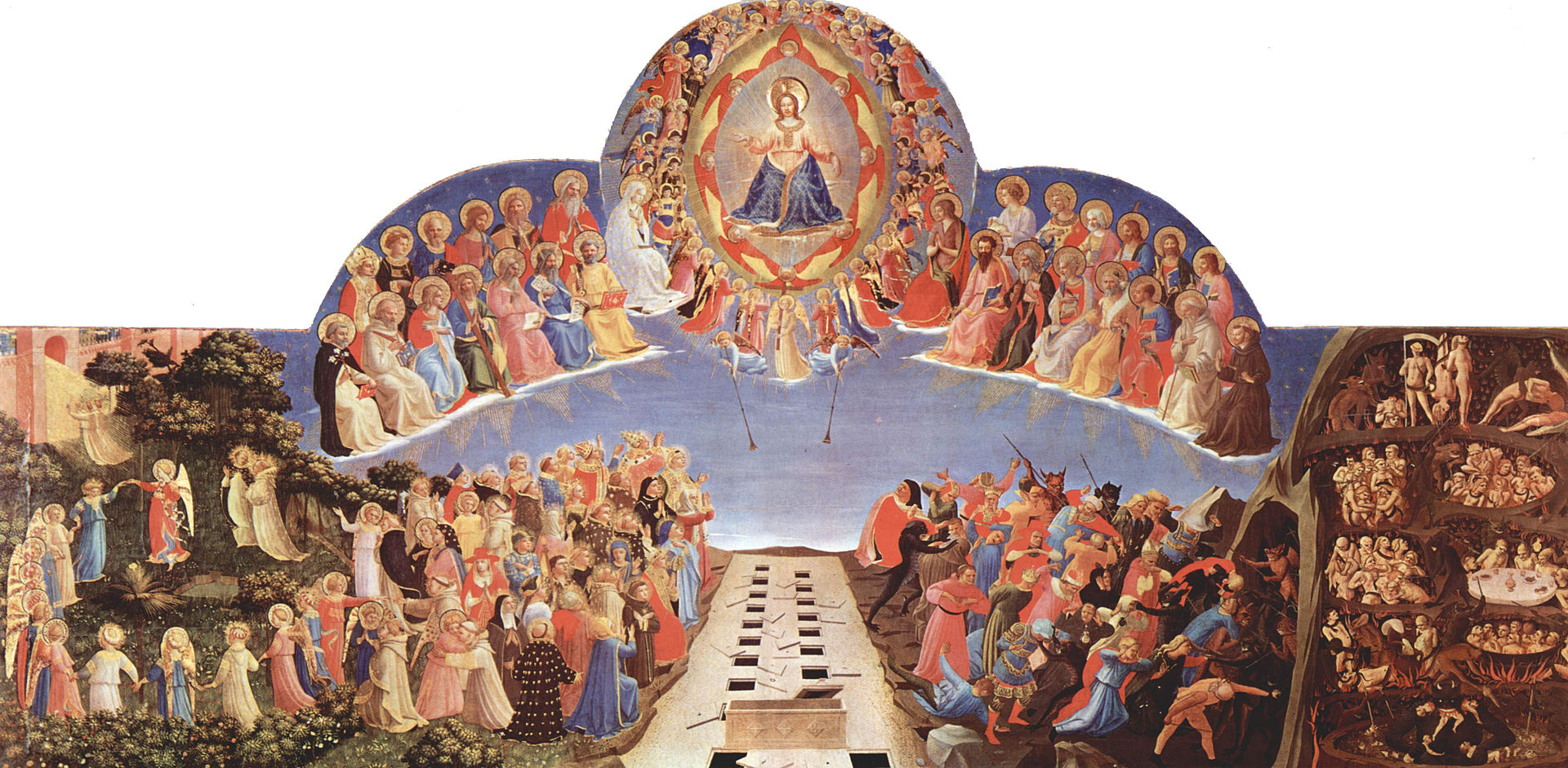
Beato Angelico’s «Last Judgment»
Beato Angelico was a 15th-century Italian painter who belonged to the Dominican order. Among his most famous works is the «Last Judgment», a tempera painting on a trapezoidal wooden panel measuring 105 x 210 cm. The unusual shape of the panel derives from the work’s intended purpose: when the famous humanist Ambrogio Traversari was elected abbot, the Camaldolese monks decided to adorn the ceremonial seat occupied by the superior in the church of Santa Maria degli Angeli with a crowning panel. Angelico was known and appreciated by the Camaldolese because he had learned the art in the workshop of their fellow monk Lorenzo.
The painting depicts the theme of the Last Judgment, that is, the moment when Christ will return to earth to judge the living and the dead, separating the righteous from sinners. Angelico drew on biblical sources and theological texts to paint the various scenes and figures in the work, but he also added innovative and original elements, demonstrating his humanistic culture and artistic mastery.
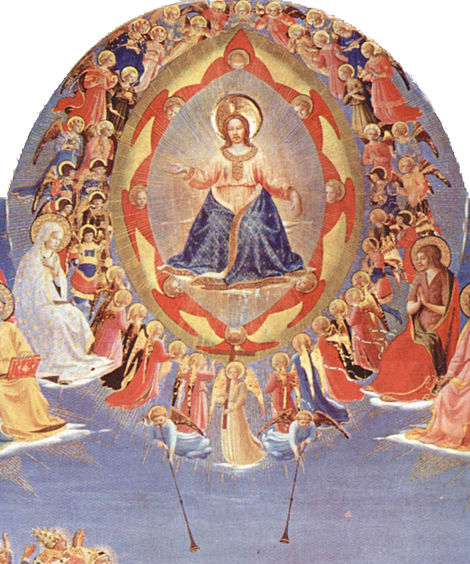
Christ the Judge
The real and ideal center of the mystery is Christ the Judge, seated on the clouds of heaven and radiating light, with the stigmata of the Crucifixion and surrounded by angels. Turning his gaze and hand to the right, he invites the elect to take their place in his kingdom of glory, while with his lowered left hand he signals the condemnation of the damned, as recounted in the Gospel: «When the Son of Man comes in his glory, and all the angels with him, then he will sit on the throne of his glory. All the nations will be gathered before him, and he will separate people one from another as a shepherd separates the sheep from the goats» (Mt 25,31-32). The figure of Christ has a pyramidal shape, alluding to the Trinity: the Father, the Son, and the Holy Spirit.
The Angels
All of heaven is turned toward Christ: the eight red seraphim forming a mandorla around him gaze at him. Seraphim are the angels closest to God and are described as fiery beings in the Book of Isaiah: «Above him stood the seraphim; each had six wings: with two they covered their faces, with two they covered their feet, and with two they flew» (Is 6,2).
The forty-one angels surrounding him in a broad ellipse are also turned toward him. The spatial effect is achieved by gradually varying their size in perspective, from those nearest to those farthest away. The angels are dressed in white or light colors, symbolizing purity and divine light.
At the foot of the ellipse, facing the viewers, are three angels: the central one raises the triumphant cross, a symbol of Christ’s victory over death and sin. The other two angels blow trumpets to awaken humanity from death, as announced by Saint Paul: «Behold, I tell you a mystery: […] in a moment, in the twinkling of an eye, at the sound of the trumpet […] the dead will be raised imperishable, and we will be changed. For this perishable body must put on imperishability, and this mortal body must put on immortality» (1Cor 15,51-53).
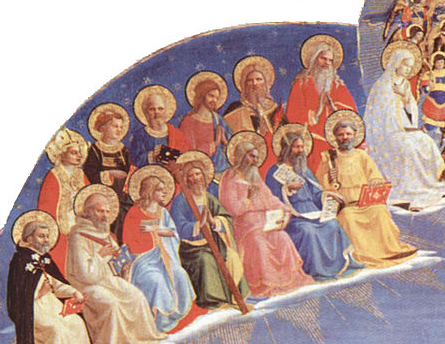
The Madonna and the Saints
To the right of Jesus appears the pleading Madonna wrapped in a mantle of light; on the other side is John the Baptist, Jesus’ forerunner, pointing to him with his right hand, wearing a garment of camel hair and a red cloak, a color suggesting his passion for God, which would lead him to give his blood rather than remain unfaithful to him.
Next come various figures, seated to Christ’s right and left, led by Peter with the keys and Paul with the sword. Beside the latter we recognize Andrew with the cross on his shoulders and, closing the series, Romuald with his hermit’s staff and the book of the Rule, followed by Francis with the stigmata. In the second row are Abel with the lamb, David with the royal crown on his head, and James with the pilgrim’s staff. Beside Peter are Moses with horns of light on his head, Philip with the cross on his shoulders, beardless John, Benedict with the discipline and the book of the Rule, and Dominic with the star above his head, the lily, and a book. In the second row are Abraham dressed in red, Bartholomew with a knife in his hand, the deacon and martyr Stephen, and finally Pope Gregory the Great.
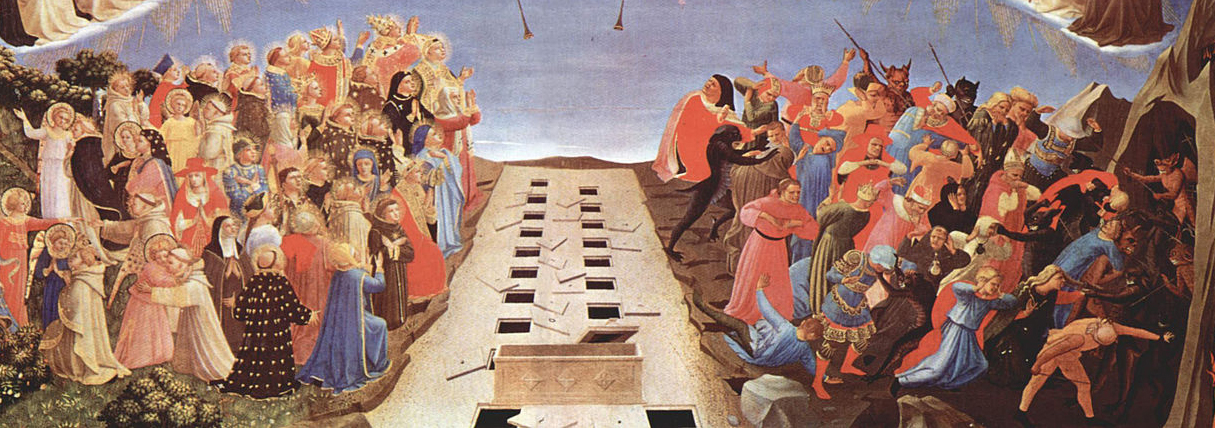
The Elect and the Damned
At the bottom center, open tombs separate the elect from the damned: the empty sarcophagus in the foreground is Jesus’. The hazy blue horizon in the distance recalls French miniatures, while the clear, distilled light symbolizes divinity and refers to the harmony of creation: «God said, “Let there be light,” and there was light. God saw that the light was good» (Gen 1,3-4).
The elect to Christ’s right gaze upward in admiration toward his glory; some embrace one another and are accompanied by angels into paradise, others dance in a circle with other angels in a garden of delights tended in the finest detail, foreshadowing the joy of heaven, while still others enter through the wide-open, radiant gate of paradise.
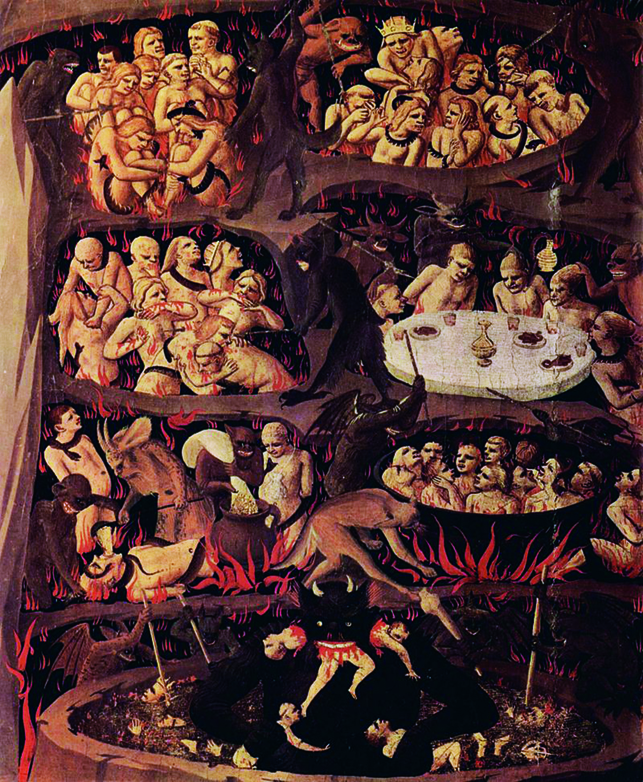
While the elect are drawn to Christ blessing them, on the opposite side the damned are driven by horrible monsters toward hell. The rocks, like pits, fill with the damned according to the categories of the vices, where they suffer punishments according to the law of contrapasso: the slothful immobilized by serpents, the lustful with serpents and toads biting their genitals, the wrathful biting one another, the gluttonous forced to abstain from the food before them, and the greedy forced to swallow molten gold. At the bottom, Satan, with three heads, devours the damned.
It is striking that each of the two groups includes people from every social class: kings, popes, princes, bishops, monks, aristocrats, and ordinary people; Angelico thus suggests that on the day of judgment there will be no titles or privileges to claim. The Lord will welcome you if you have recognized him in the poor, the hungry, those who are needy and marginalized, those who suffer and are alone, because this is precisely one of the fundamental criteria for examining Christian life, by which Jesus invites you to measure yourself every day: «Truly I tell you, whatever you did for one of the least of these brothers and sisters of mine, you did for me» (Mt 25,40).
Then “your” Last Judgment will not be so much about the evil you have or have not committed as about the good you have or have not done!


