




The collaboration between Father Alessio Fucile, an art expert, and the Shalom blog continues. Father Alessio will guide us in exploring the most important moments of the liturgical year through beautiful works of art that, besides inspiring wonder at their splendor, can help us better understand the Holy Scriptures and Jesus’s message.
Today, Father Alessio presents the painting “Saint Joseph the Carpenter,” which can be admired at the Louvre Museum in Paris, to celebrate today’s liturgical feast.
Georges de La Tour, the undisputed master of French Caravaggism, created around 1642 the work “Saint Joseph the Carpenter,” now carefully preserved at the Louvre Museum in Paris. Famous for his nocturnal scenes and chromatic contrasts between light and shadow, De La Tour paints an utterly everyday setting immersed in darkness, with shadows stretching across the surfaces: it is a carpenter’s workshop, as various tools scattered across the floor attest.
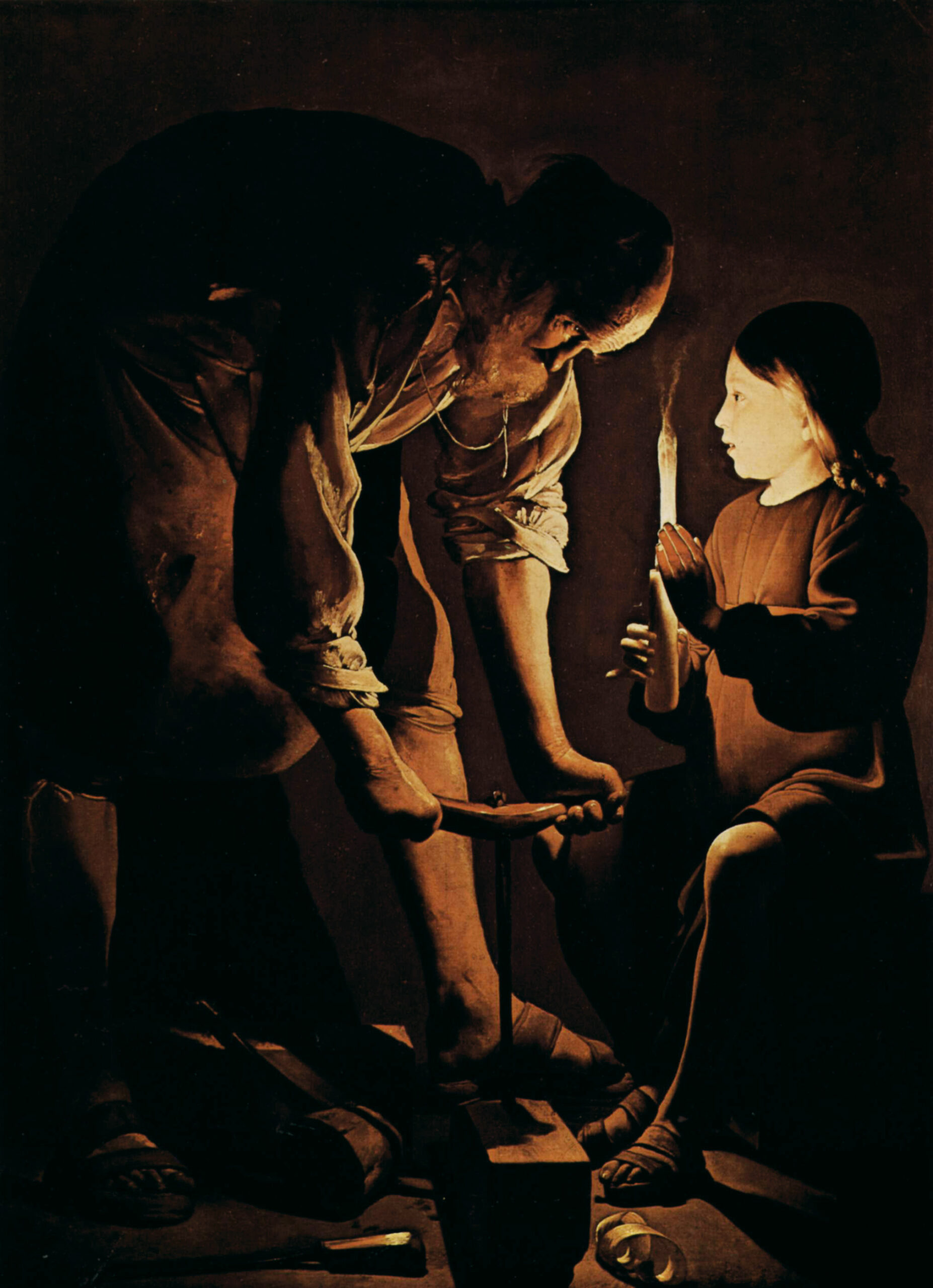
At the center of the scene, the young Jesus holds a candle, a symbol of the divine light he brings to humanity. De La Tour’s technique shines through in his ability to render the fingers of Jesus’s left hand transparent, while his right hand shields the flame, creating a play of shadows that accentuates its translucency. Jesus’s face, the brightest point in the painting, seems to radiate light from his cheeks, recalling Christ’s words: “I am the light of the world; whoever follows me will never walk in darkness, but will have the light of life” (Jn 8:12).
Joseph is depicted working the wood, bent forward and intent on drilling a beam with an auger. This action alludes to the nails that will fasten Christ to the cross. Joseph’s wrinkles and posture, with his sleeves rolled up, express his dedication and concern for his son’s future.
At first glance, the work might seem to depict a son learning his father’s trade. However, De La Tour shows us a Joseph who bows before the child, illuminated by his presence. Joseph’s wrinkled forehead symbolizes the wisdom of one who places his trust in God.

Jesus’ left hand, translucent and blessing, foreshadows the sacrifice of the cross and the illumination that will result from it, as John emphasizes: «The true light that enlightens everyone was coming into the world» (Jn 1:9).
Jesus, his gaze fixed on Joseph’s face, seems to contemplate the inner beauty of the man who raised him with love. Their silent communication, conveyed through looks and gestures, is the beating heart of the painting. I conclude with a prayer for today’s remembrance: «Joseph, man of faith, teach me to trust even when the path is dark.
Help me find peace in my story, full of meaning even though it turned out differently from how I had imagined it. Open the hearts of those who have lost faith, and give them dreams that change their perspective. Those who look with hope, even when faced with a wall, can already glimpse freedom.»


