




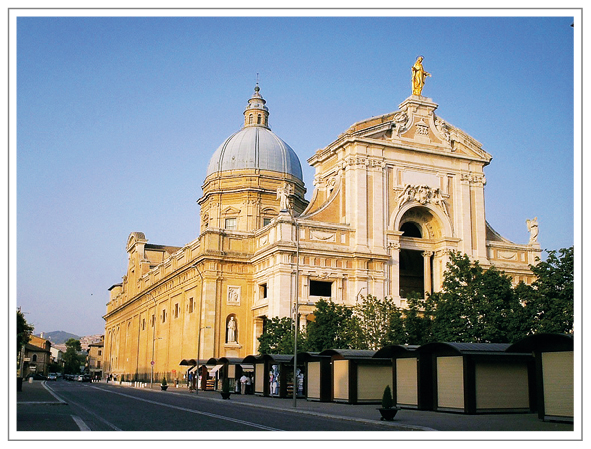
The great Basilica of Santa Maria degli Angeli was built at the request of Pope Saint Pius V between 1569 and 1679. It was severely damaged by an earthquake in 1832, then restored and its façade radically redesigned.
The building was constructed to preserve within it several places associated with Saint Francis, which over time became pilgrimage destinations for an ever-growing number of the Saint’s devotees. Inside are the Porziuncola, the Chapel of the Transit, the Chapel of the Roses, and the Rose Garden.
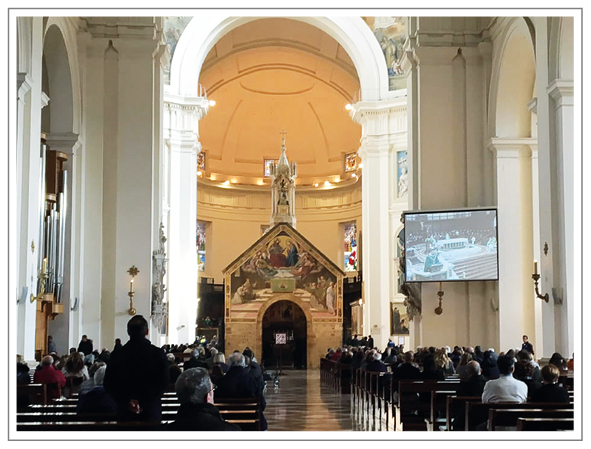
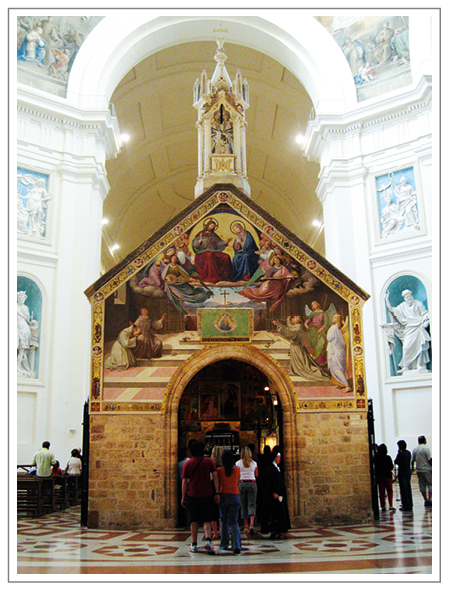
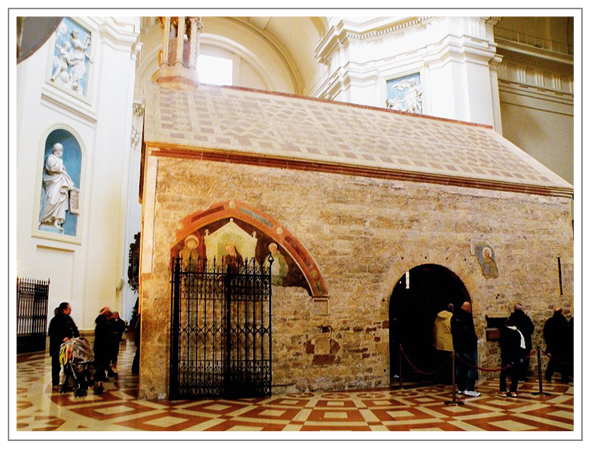
The Porziuncola
Located at the center, beneath the basilica’s dome, it is the heart of the sanctuary, as it is one of the most important Franciscan sites: within its walls, Saint Francis clearly understood his vocation and founded the Order of Friars Minor here in 1209, entrusting it to the protection of the Virgin Mother of Christ, to whom the little church is dedicated; here he welcomed Saint Clare, and in 1216, in a vision, Francis obtained from Jesus himself the Indulgence known as the “Porziuncola Indulgence” or “Pardon of Assisi”, approved by Pope Honorius III (the in-depth resource on the Pardon of Assisi is taken from Messalino Sulla Tua Parola, July-August 2022 bimonthly issue, code 511).
To learn more about the Pardon of Assisi, download the in-depth resource.

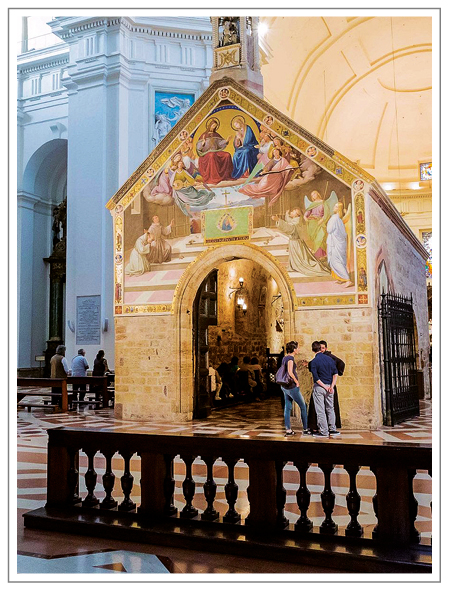
The Chapel of the Transit
This is a simple stone room that served as the infirmary of the original convent. Here Saint Francis spent the last days of his life and, laid naked on the bare earth, died on the evening of October 3, 1226, after composing the final verses of his Canticle of the Creatures.
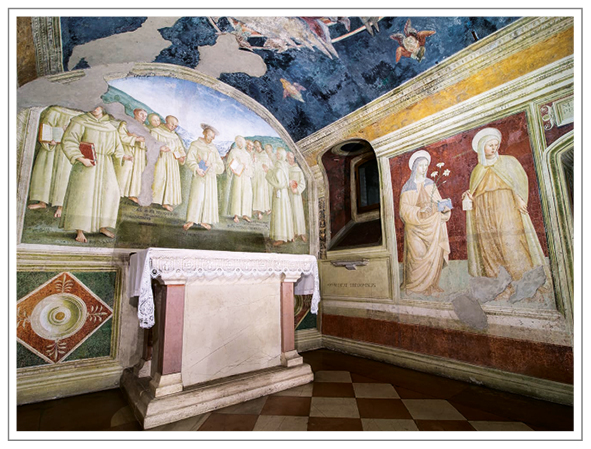
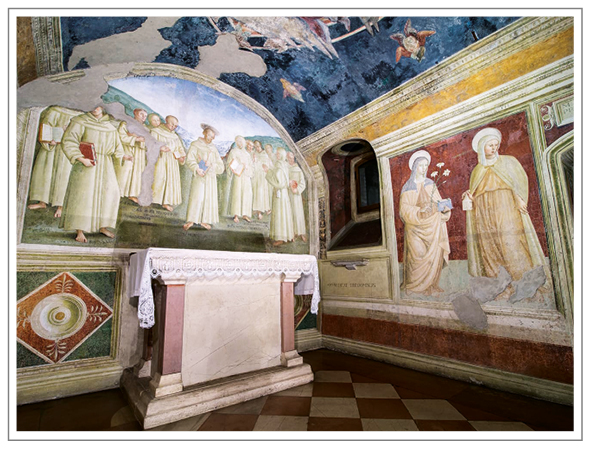
The Chapel of the Roses
This is where the hut that originally housed Saint Francis stood. It was transformed into a chapel at the request of Saint Bonaventure of Bagnoregio around 1260 and enlarged by Saint Bernardino of Siena around 1440.
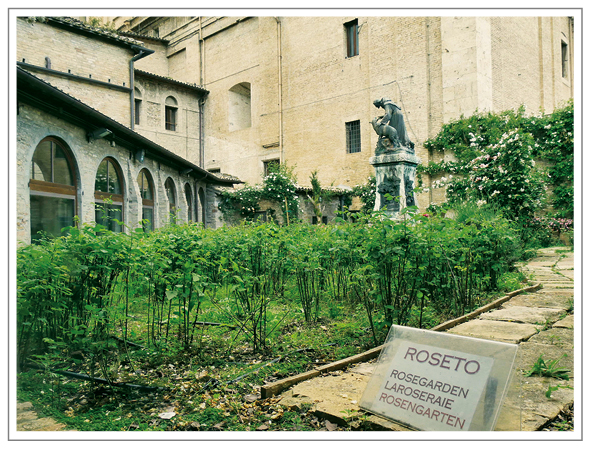
The Rose Garden
This area of the sanctuary is all that remains of the ancient forest where the friars lived. Here you will find the Rose Garden, among whose thorns Francis rolled one night to overcome doubt and temptation. According to a tradition attested as early as the end of the 13th century, when the brambles came into contact with the body of the Little Poor Man, they turned into thornless roses, giving rise to the “Rosa Canina Assisiensis”, which still blooms today only at the Porziuncola.
Discover the Sanctuary

Basilica of Santa Maria degli Angeli – Porziuncola
Piazza Porziuncola, 1
06081 Santa Maria degli Angeli (PG)
Basilica Information Office
Tel. (+39) 075 80 51 430
Fax: (+39) 075 80 51 418
Basilica Sacristy
(+39) 075 80 51 432
How to get there the Sanctuary


