




From the very beginning, the life of Saint Francis of Paola is blessed by God with every kind of grace. Before long, his curriculum is enriched by numerous extraordinary miracles. Born in Paola (Cosenza) on March 27, 1416, into a family of modest means in which faith held a privileged place, he would often say: «It is faith that works miracles!», to make it clear that it was not he who healed or solved the problem, but God. Many of his miracles still impress people today because of their exceptional nature. Here are some of the most famous.
The Little Lamb Martinello Returns to Life
Martinello is the name Francis gave to a little lamb he was very fond of. During the construction of the church in Paola, the hungry workers decide to cook and eat it, after which they throw the bones and remains into the furnace. Upon discovering what happened, Saint Francis arrives at the furnace shouting: «Martinello, Martinello, come here». And behold, the animal emerges unharmed from the flames and runs toward him. Martinello’s resurrection is so symbolic that the saint is often depicted holding a little lamb in his arms.

The Furnace in Flames
During the construction of the monastery in Paola, a large fire suddenly breaks out in the furnace used to prepare the bricks. The flames soon reach the beams, to the point that the entire ceiling risks collapsing, with the danger of losing everything. The workers try in vain to fight the fire, attempting to seal the cracks with stones and earth. Not knowing what to do, they call the saint, who calms everyone by saying: «For the love of God, my children, do not worry, because the furnace will not collapse. In the meantime, go have breakfast; God will take care of it». The workers leave, and the friars see Francis enter the furnace amid the flames. When he emerges, he is unharmed, safe and sound, and the furnace is as good as new.

The “Cucchiarella” Spring
To continue building the monastery, a water source is needed near the work area, so that the workers do not always have to reach the distant Isca stream. And so Francis strikes a rock with his staff and immediately makes a spring gush forth.
This water is drawn using ladles and spoons: hence the name “Cucchiarella” given to the spring by the faithful, who draw the water even today, believing it to have healing properties.
The Stones of the Miracle
During the construction of the Paola monastery, a landslide breaks away from the mountain, and two huge boulders are about to overwhelm the building and the workers at work. Francis notices them and, addressing the boulders, shouts: «Stop, for goodness’ sake!»; at which point the two enormous rocks remain suspended in a precarious balance. Had they struck the monastery, they would have caused incalculable loss of life and damage. Even today, defying the law of gravity, the stones remain balanced, despite the fact that the center of gravity of both is considerably off-center.

His nephew Nicola
The miracles of Saint Francis mainly concern aid to the sick, for whom he performs miraculous healings, including paralytics, lepers, the blind, the possessed, and even the resurrection of his nephew Nicola, the son of his sister Brigida. The young man wishes to embrace the religious life with him, but his mother Brigida does not allow it. One day Nicola falls seriously ill and dies. He is taken to Saint Francis’s church for the funeral rites and, when the time comes to place him in the grave, the Saint orders that his nephew be taken to his poor cell. Before the young man’s corpse, he weeps and prays at length, raises him from the dead, and returns him to his sister, making her promise that she will never again hinder her son’s desire to devote himself to God.
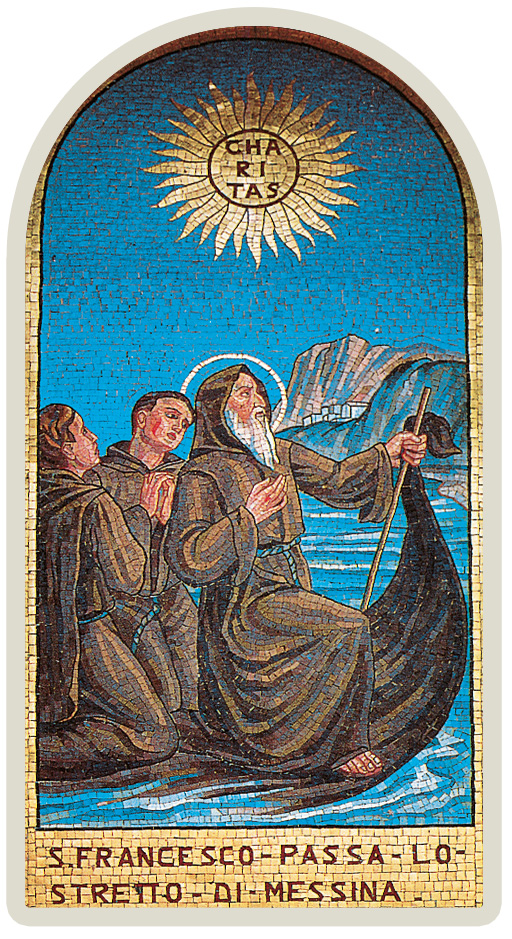
The sea crossing with his cloak
His best-known miracle is the one documented in April 1464. Saint Francis set out with two fellow friars toward the Reggio coast, to board a ship for Sicily and found a convent in Milazzo. Upon reaching the port, he asked the owner of a boat loaded with timber, preparing to sail for Messina, and begged him, for the love of Jesus Christ, to take him and his two fellow friars aboard to cross the Strait. When the boatman realized that the friars had no money to pay him, he refused to ferry them. Without insisting further, Francis told his companions to wait for him a moment and knelt down to pray. He rose, blessed the sea, and at that moment everyone present saw him spread his cloak over the waves, climb onto it, and, holding one edge tightly at the upper end of his staff as if using it as a sail, proceed swiftly and safely toward Messina.
The Devil's Bridge
Legend has it that the Saint planned to build a bridge, still crossed and admired by hundreds of pilgrims, to facilitate passage from one bank of the Isca stream to the other. Then the devil appeared to him and offered to build it himself in a single night in exchange for the soul of the first traveler to cross it. The Friar accepted, but the next day, when the devil arrived to collect what had been agreed, Saint Francis cleverly had a dog cross and invited the devil to take the animal's soul. Furious at being deceived, the devil violently struck the parapet wall, creating a hole and leaving the imprint of his hand on the opposite wall.
The greatest miracle
Miracles, speaking plainly, encouragement, and standing beside people are merely expressions of the charity that Francis draws from God's merciful love, which continually stoops down to human misery to clothe humanity with the dignity of being children.
Therefore, Francis wants to show the way to God and His plans of love; he wants to accompany people in their conversion, leading them to live their faith fully.
The greatest miracle a person can ask for is to have faith.


