




The collaboration between Father Alessio Fucile, an art expert, and the Shalom blog continues. Father Alessio will guide us in exploring the most important moments of the liturgical year through beautiful works of art that, besides inspiring wonder at their splendor, can help us better understand Sacred Scripture and Jesus’ message.
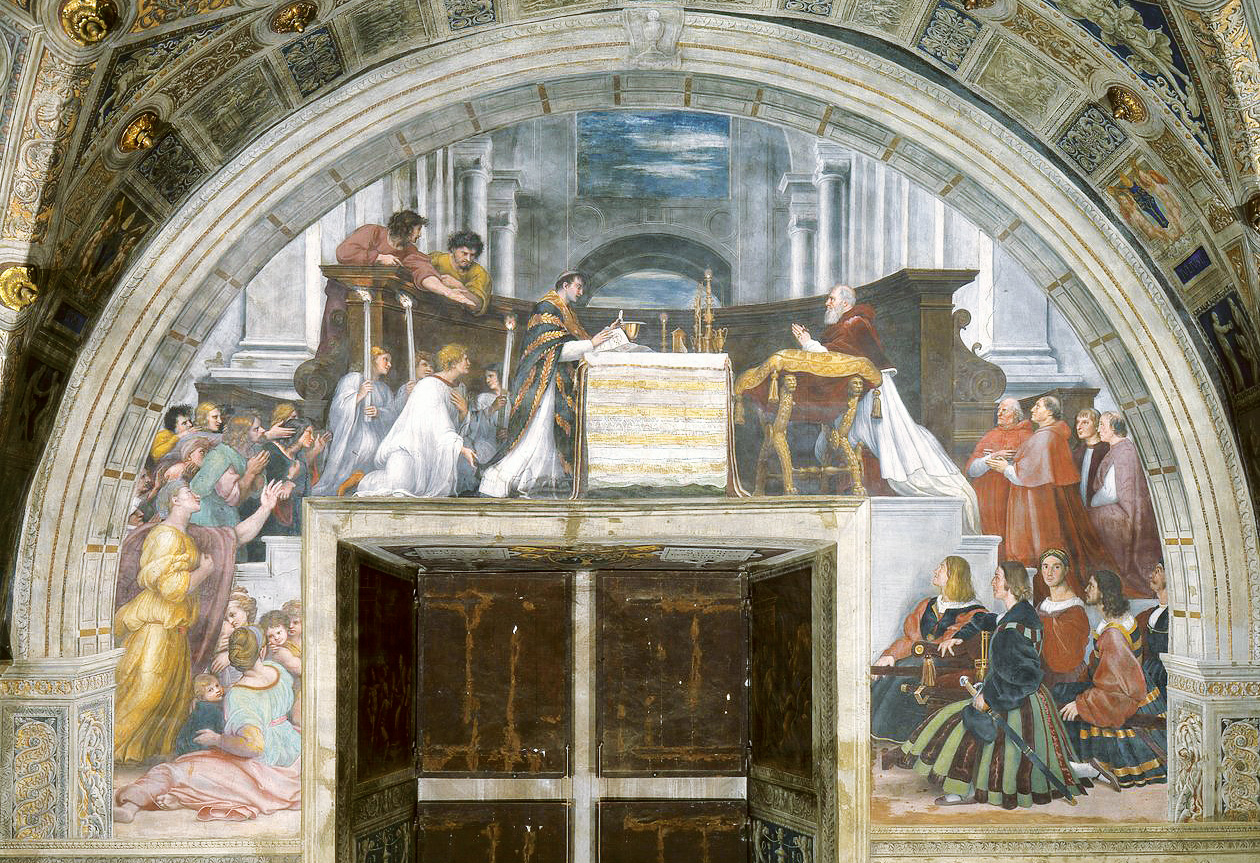
Today, Father Alessio presents Raphael’s fresco “The Mass at Bolsena,” which can be admired in the Room of Heliodorus in the Vatican.
Doubt and Faith: A Priest’s Journey Toward the Truth
The event tells of a Bohemian priest, Peter of Prague, who, doubting Jesus’ real presence in the Eucharist, undertook a pilgrimage to Rome to calm his inner turmoil. During the journey, he stopped in Bolsena and asked to celebrate Mass in the grotto of Saint Christina. As he broke the host, blood began to flow from the bread, staining the corporal and the priest’s vestments, with a few drops even falling onto the floor. The priest tried to hide what had happened, but in vain. The faithful present witnessed it and proclaimed the miracle. The corporal was transported to Orvieto, where Pope Urban IV resided at the time; in memory of the event, he instituted the feast of Corpus Christi. The texts for the celebration were composed by Saint Thomas Aquinas. Orvieto Cathedral was built to safeguard the corporal, and its façade reflects the shape of the reliquary that contains it.
The prodigious event strengthened the priest’s uncertain faith: Jesus, truly present in the consecrated bread and wine, confirmed his promise: “I am with you always, until the end of the world.”

Raphael Sanzio: Master of Art and Narrator of the Faith
Raphael depicted the event with ingenious mastery. He used the obstruction of the window as the setting for the scene. The priest, dressed in green vestments indicating the Ordinary Time in which the miracle took place, gazes in astonishment at the miracle unfolding in his hands, above the altar with golden stripes. In his heart, Jesus’ words may have echoed: “My flesh is true food and my blood is true drink.”
The faithful present react fervently to the miracle, in keeping with Raphael’s expressive language, which uses movement and emotional involvement. Particularly original is the movement of the candle flames held by the altar servers, symbols of the faith that illuminates humanity’s path.
Figures and symbols
The two figures behind the celebrant express the human response to the mystery and the miracle. They are engaged in animated discussion: one appears doubtful, while the other, with his hand extended, seems to urge him: «Look, can’t you see for yourself?».
Pope Julius II, an anachronistic figure in relation to the event, is depicted kneeling and leaning on a large cushion in adoration before the bleeding host. The pope’s long beard alludes to a vow he made to keep until he had freed the Italian peninsula from foreigners. In the background are four cardinals: Leonardo Grosso della Rovere, Raffaele Riario, Tommaso Riario, and Agostino Spinola. The chair bearers also participate in the Mass, kneeling in adoration.

The Eucharist: the heart of the scene and the focus of faith
The Eucharist is at the center of the scene and attracts almost everyone’s gaze. Only a child and one of the chair bearers look toward the viewer. The child, a symbol of pure faith, invites us to believe in and trust Jesus, who makes himself small and weak, to the point of becoming present in a piece of bread. The child believes without hesitation, entrusting himself to one who knows more than he does. Jesus said: «Unless you change and become like little children, you will never enter the kingdom of heaven». Those who believe entrust themselves to God’s love, just as little ones entrust themselves to their mother’s care. The chair bearer who turns toward the viewer seems to ask: «And you, do you believe?».
The Incarnation and the Eucharist are manifestations of God’s love, which gives itself. The sacrifice on the cross and that on the altar are one and the same sacrifice, a self-gift that reaches all humanity across time and space. It is the story of a God who continually seeks new ways to enter into communion with his children. He seems to say: «I created you, I gave you all my love, I guided you, I offered you my support: where are you, where is your response, where is your love? What else must I do for you? I will not give up; I will continue to seek you». Thank you for your attention.


