




The Eucharistic miracle
What people are willing to do for love! And it is precisely a love story that lies at the origin of the Eucharistic miracle whose relic is still preserved in the cathedral of Alatri (today the co-cathedral of the Diocese of Anagni-Alatri).
The event took place in 1228, when a girl, little more than an adolescent, heartbroken because a love was no longer reciprocated, turned to a sorceress to win back the love of her beloved. “Go,” said the witch, “bring me a consecrated Host from your church, and I will give you a powerful potion that will bring your young man back to your heart.”
The naive girl, just to get back the object of her desire, went to Mass and, after receiving Communion, managed to take the consecrated Host home unseen, wrapped in a handkerchief. She then hid it inside the bread chest.
For three days, she agonized over what to do: take the Host to the sorceress or return it to the priest? When she decided to take the consecrated Host to the witch, she was astonished upon opening the bread chest: instead of the white Host, she found a Host of “living flesh.”
Frightened, she ran to the priest and confessed her terrible sin. The priest went to retrieve the Host and took it to the Bishop, who wrote to Pope Gregory IX to inform him of what had happened and ask his advice on what to do.
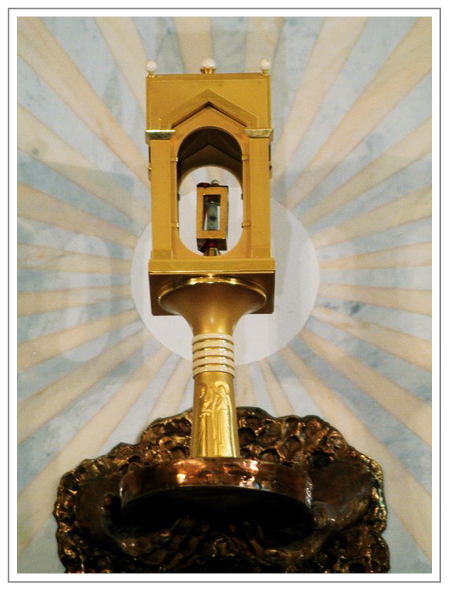
The relic of the Host transformed into flesh is now preserved in a monstrance case, permanently displayed in a chapel in the right aisle of the co-cathedral basilica of Saint Paul.
The incarnate Host is held between two cotton balls and placed in the form of a dark-colored pellet inside a 4-cm-high glass tube, which is itself enclosed in the gilded metal monstrance-reliquary. The shaft bears the inscription: “The Word became flesh and dwelt among us.”
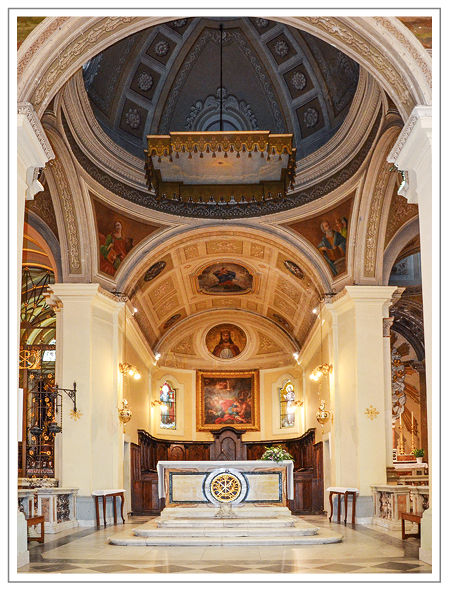
On the side walls of the church, a series of frescoes depicts the story as it has been handed down.
The cathedral
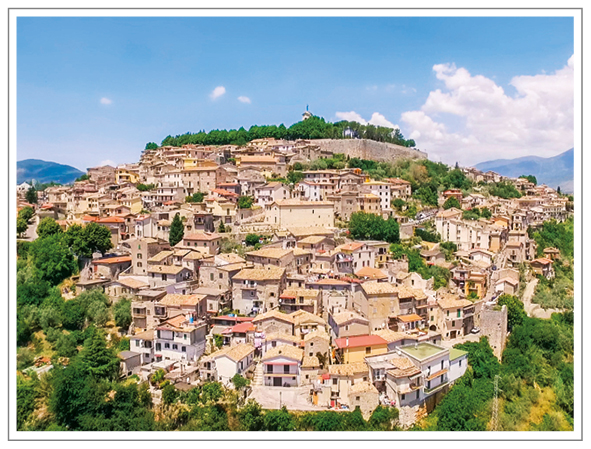
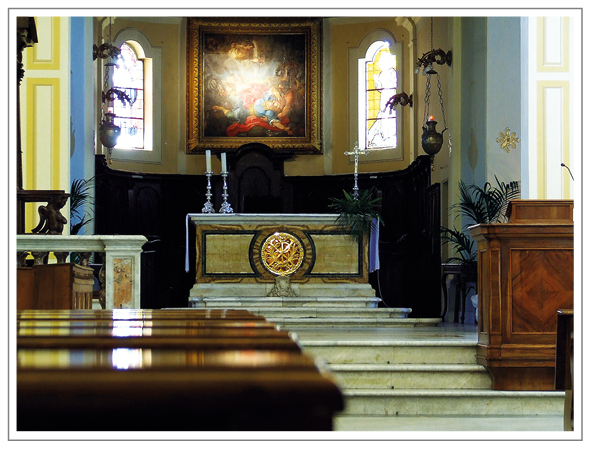
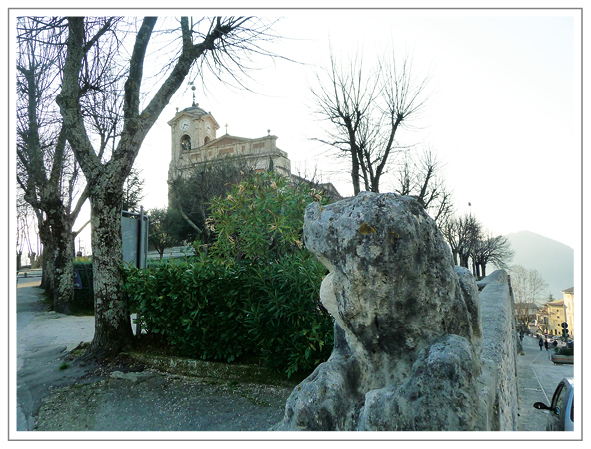
The cathedral stands at the center of the esplanade of Alatri’s acropolis, on the remains of an ancient altar and a temple dedicated to Saturn. Records of an ancient cathedral date back to before the year 1000. During the pontificate of Pope Innocent II (1130-1143), the relics of the martyr Pope Sixtus I were transferred to Alatri, and on this occasion the ancient cathedral was renovated; the high altar was completed in 1156. Further additions were made in the thirteenth century, when the rood screen and ambo were added for Pope Honorius III’s visit to the city. Precious remains of these architectural elements are still preserved in the church today.
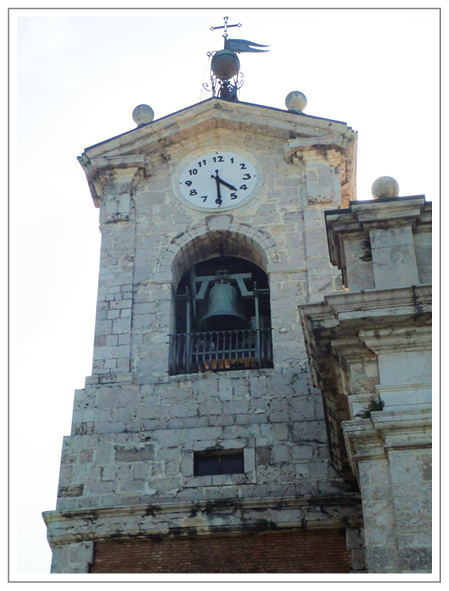
During the sixteenth century, the walls were frescoed with scenes depicting the transfer of the relics of Saint Sixtus. These paintings have now disappeared as a result of modernization work carried out in the seventeenth and eighteenth centuries, which transformed the church into the form we can admire today. The current façade and bell tower were added by Jacopo Subleyras between 1790 and 1808, and the attic and pediment were added in 1884. Finally, in 1932, the Chapel of Saint Sixtus was built to house the saint’s relics on the occasion of the eighth centenary of their transfer to Alatri.
The façade, made of stone and brick, dates from the late eighteenth century. The interior is laid out in a Latin cross with three naves divided by pillars and an elevated transept. In addition to the relics of Pope Sixtus, the cathedral also houses, at the back of the right nave, the relics of the Roman martyr Alexander, brought from the catacombs of San Callisto and transferred to Alatri in 1640.
Learn about the Sanctuary

Basilica of Saint Paul the Apostle (Co-Cathedral)
Piazzale dell’Acropoli
03011 Alatri (FR)
Tel. 0775 434523
How to get there the Sanctuary

You may be interested


