




Introduction
During Advent, on the Third Sunday, and during Lent, on the Fourth Sunday, the priest may come to the altar wearing a rose-colored chasuble, or more precisely, a rosaceous one. This choice might provoke a few giggles, but rose has been part of the Church's tradition for many centuries and has profound symbolic value for understanding even more deeply the season in which it is worn.
Are you curious to discover the meaning of the rose color, the rarest and most joyful of the liturgical colors? Then keep reading the article!
The rarest liturgical color
Rose is a rare liturgical color that we see on the altar only twice a year: on the Third Sunday of Advent, known as Gaudete Sunday; and then on the Fourth Sunday of Lent, called Laetare Sunday.
During the liturgy, the priest changes the color of the vestments he wears according to the liturgical season or the type of Mass being celebrated, thereby giving different importance to the rites he is performing. Indeed, every liturgical color has a very specific meaning that every member of the faithful should know in order to participate in the celebration with greater awareness.
Rose, together with red, white, green, and violet, is among the official liturgical colors mentioned in the General Instruction of the Roman Missal (no. 346).
But how did these liturgical colors come to be established?

A brief history of colors in the liturgy
Liturgical colors were not established at the beginning of Christianity but developed gradually. White probably appeared from the fourth century onward and was used until the ninth century for the liturgy of Ordinary Time.
Over the centuries, various colors became widespread, but their use was never fully standardized throughout the Church's celebrations.
Only in the 1200s was the first attempt made to standardize the use of color, on the initiative of Innocent III. He established a first canon based on the four liturgical colors in use at that time in the Church of Rome: white for feast days, red for Pentecost and the feasts of martyrs, black for Advent and Lent, and green for ordinary days. Violet was later added as a substitute for black (a symbol of mourning and penance), permitted on the Gaudete and Laetare Sundays.
Later, Pius V established, in the Roman Missal of 1570, guidelines on the use of liturgical colors valid for the entire Church: green for Ordinary Time; white for feasts of the Lord and of saints who are not martyrs; red for Pentecost, the feasts of the holy martyrs, and the Feast of the Holy Cross; violet for Advent and Lent; and black for funeral celebrations and Good Friday. It was precisely at this stage that rose was added to the liturgical colors. This happened because, since violet replaced the black of Lent and Advent, a new color had to be found in place of violet to preserve the particular significance of the two Sundays, Gaudete and Laetare. And so the choice fell on rose, so as not to depart too far from violet, which nevertheless remains the reference color for Advent and Lent. Violet, in fact, can become pink only with a great deal of white (that is, much light) and a touch of red (that is, the love and passion of the Savior).
The present-day use of colors has remained almost unchanged and is established in the General Instruction of the Roman Missal (no. 346). Regarding the rose color, this number specifies that “it may be used, where it is the practice, on the Sundays of Gaudete (the Third Sunday of Advent) and Laetare (the Fourth Sunday of Lent).”
So why the rose color?
Violet, therefore, is softened, brightened by hope, and becomes rose-colored to signify the joy that is already savored in anticipation: the joy of Christmas, now imminent, arising from the awareness that God is with us, is on our side, is present in our lives, and wants to renew us with his love.
The rose-colored vestment worn by the priest is an invitation to joy for the faithful at the coming of the Son of God among humanity (Advent) and at his resurrection (Lent). This invitation becomes a call to constant joy as a way of life to embrace in facing everyday life: “Rejoice in the Lord always. The Lord is near!” (Phil 4:4-5). And this is precisely the role that vestments of this color have on these two special Sundays: to remind the faithful that even in moments of waiting, suffering, sadness, and trial, there can be joy - the joy that derives from the work of universal salvation accomplished by Jesus, which begins at Christmas and reaches its fulfillment at Easter. Joy that does not come from us but from the Holy Spirit.
Pope Francis reminds us that what the Lord offers us “is true life, the happiness for which we were created. He wants us to be saints and does not expect us to settle for a mediocre, watered-down, insubstantial existence” (Gaudete et exsultate 1).
Saint Joseph: the first to wear rose
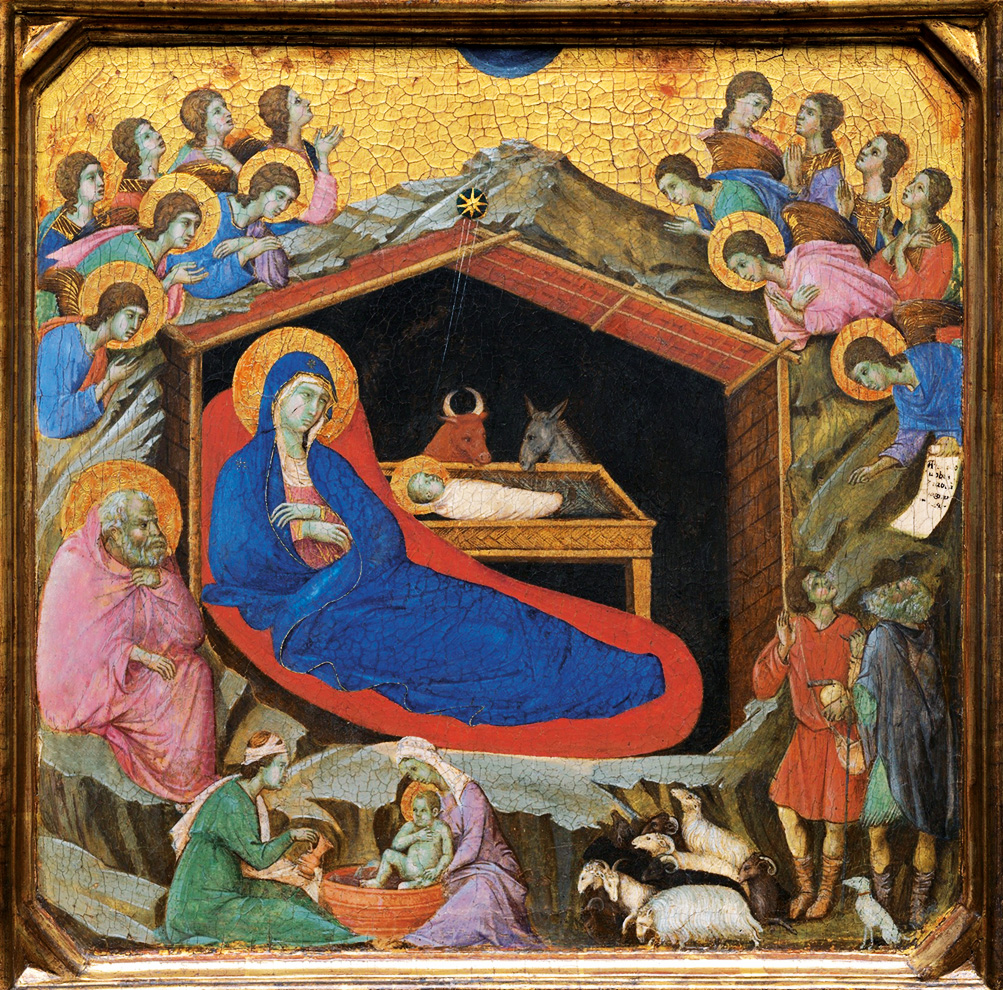
Duccio da Buoninsegna’s Nativity also portrays Saint Joseph. He is outside the grotto on the left, seated on the jagged rocks surrounding the shelter, and his peripheral yet attentive position emphasizes his role in the Holy Family. He “does not seek shortcuts, but faces ‘with his eyes open’ what is happening to him, personally assuming responsibility for it” (Pope Francis, Patris corde), namely, that of guardian of the Virgin and the Child. However, what stands out is that he is the one wearing pink, the color assigned specifically to the Third Sunday of Advent. In this way, Saint Joseph shows us the joy of the Savior’s birth, the “everyday, transparent joy of simplicity, the joy experienced by those who safeguard what matters: faithful closeness to God and to one’s neighbor” (Pope Francis, Patris corde). Through his attentiveness and willingness to be guided by the words of the Lord’s angel, he challenges us and asks us to examine the quality of our faith. What do I need to recover so that, like Saint Joseph, I too may be faithful to God in my life every day?
Seeing the rose color at Mass encourages us to fill our hearts with joy and to turn our gaze toward the now imminent celebration of Christ’s Nativity! His coming is near. We know that God himself is coming to visit us! Let us rejoice with joy and run to meet him! May the Virgin Mary help us direct our steps toward Bethlehem, to meet the Child who is born for us and to open our hearts to joy!
The Third Sunday of Advent is just around the corner: if you would like to purchase a rose-colored chasuble for your parish, go to this link:


