




The collaboration between Father Alessio Fucile, an art expert, and the Shalom blog continues. Father Alessio will guide us in exploring the most important moments of the liturgical year through beautiful works of art that, besides inspiring wonder at their splendor, can help us better understand Sacred Scripture and the message of Jesus.
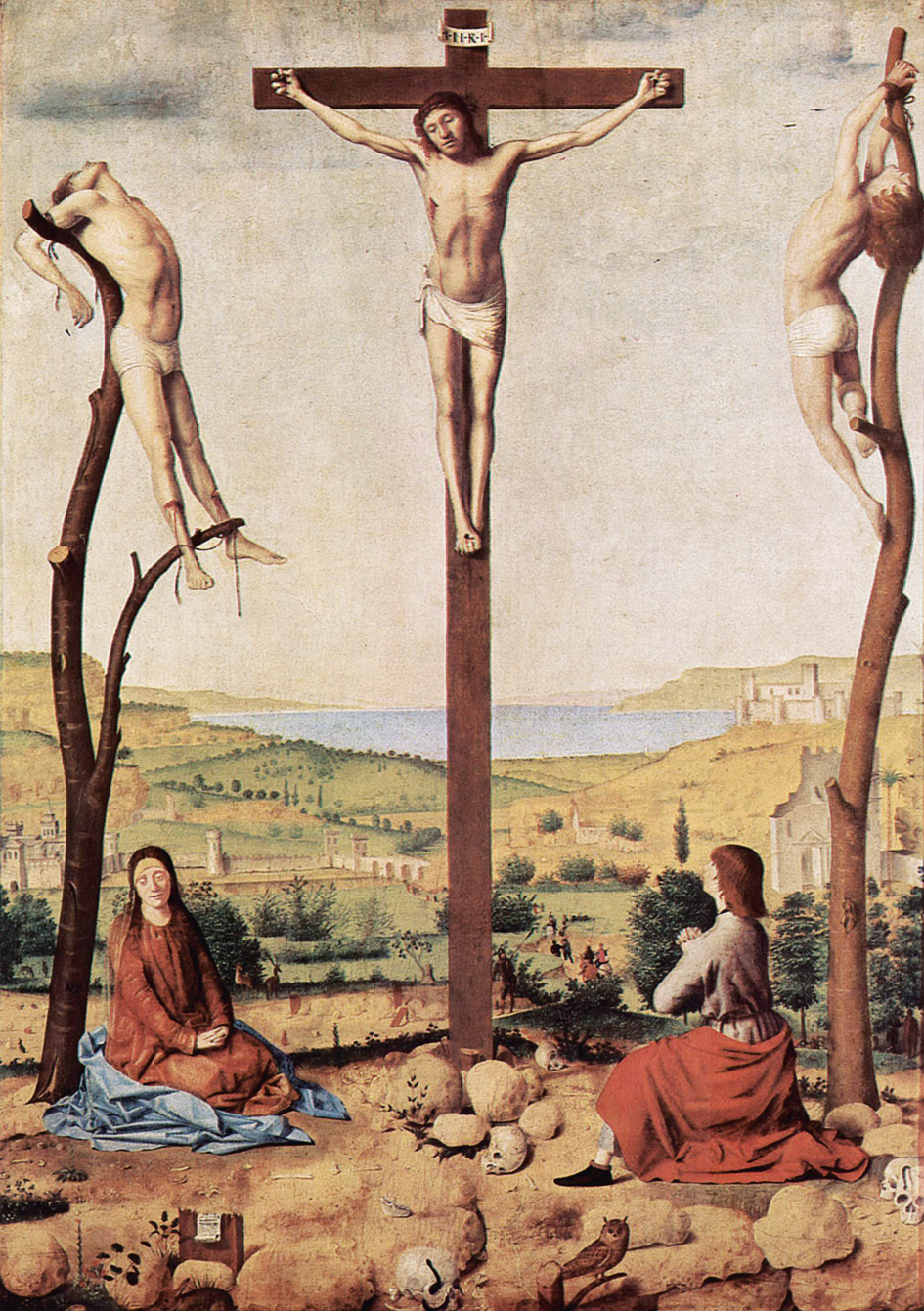
Today, Father Alessio presents “The Crucifixion” by Antonello da Messina, which can be admired at the Royal Museum of Fine Arts in Antwerp.
Today we will examine the “Crucifixion,” a masterpiece housed at the Royal Museum of Fine Arts in Antwerp, created by the celebrated Sicilian painter Antonello da Messina. Painted in Venice in 1475, this work is signed and dated on a cartellino placed at the lower left, on a broken board planted in the ground. The panel’s modest dimensions reflect its original purpose: an object of private devotion.
Antonello da Messina’s virtuosity
Antonello da Messina demonstrates his artistic virtuosity by blending the techniques of Flemish painting and the early Italian Renaissance. From the former, he adopts the elevated compositional scheme of the Crucifixion and exceptional precision in depicting details. From the latter, he takes the careful study of perspective and the anatomical representation of bodies, preferring the dignity of the human form to the harshness of the Passion.
The cross at the center of the image
The cross, with Jesus at the center, dominates the painting with its monumentality. It is dark and linear, and perfectly aligned with the viewer’s gaze. On either side, the thieves writhe on bare, gnarled trees. Mary and John, immersed in silence, observe the scene, evoking the passage from the Gospel of John: “When Jesus saw his mother and the disciple whom he loved standing beside her, he said to his mother, ‘Woman, here is your son!’. Then he said to the disciple, ‘Here is your mother!’. And from that moment the disciple took her into his home.” Antonello delicately portrays Mary’s pain and Jesus’ invitation to regard her as the universal mother. Jesus, stripped of everything, in a gesture of supreme detachment, gives his mother to the whole world before completing his mission through the sacrifice of his life.

The landscape and the scene
The background landscape and the castle by the sea evoke the coast of Messina, while the scene is animated by a variety of animals and figures, depicted with meticulous care. Rabbits and deer mingle with soldiers and civilians along the road to Calvary toward Jerusalem, visible on the left side of the painting.
The symbolism
Symbolic elements scattered throughout the work encourage meditation and prayer: the red flowers foreshadow Christ's Passion; the skulls and bones evoke Golgotha, the place of the crucifixion; the serpent emerging from a skull represents original sin overcome by Christ's sacrifice; the owl may allude to the Jews who did not recognize the Messiah.
The central cross symbolizes the glorification of Christ, uniting his humiliating descent into earthly life with the triumph of the Resurrection. Antonello uses a visual device, lowering the landscape's vanishing point to emphasize the cross, suggesting that, even in the act of dying, Christ does not lose his divinity but elevates humanity.

I will conclude with a reflection by Pope Francis: “«Jesus, teach us that the cross is the way to resurrection, that God never forgets any of his children and never tires of forgiving us and embracing us with his mercy. Teach us never to tire of asking for forgiveness and believing in the Father's boundless mercy». Thank you for your attention.


