



The collaboration between Father Alessio Fucile, an art expert, and the Shalom blog continues. Father Alessio will guide us in exploring the most important moments of the liturgical year through beautiful works of art that, besides inspiring wonder at their splendor, can help us better understand Sacred Scripture and Jesus’ message.
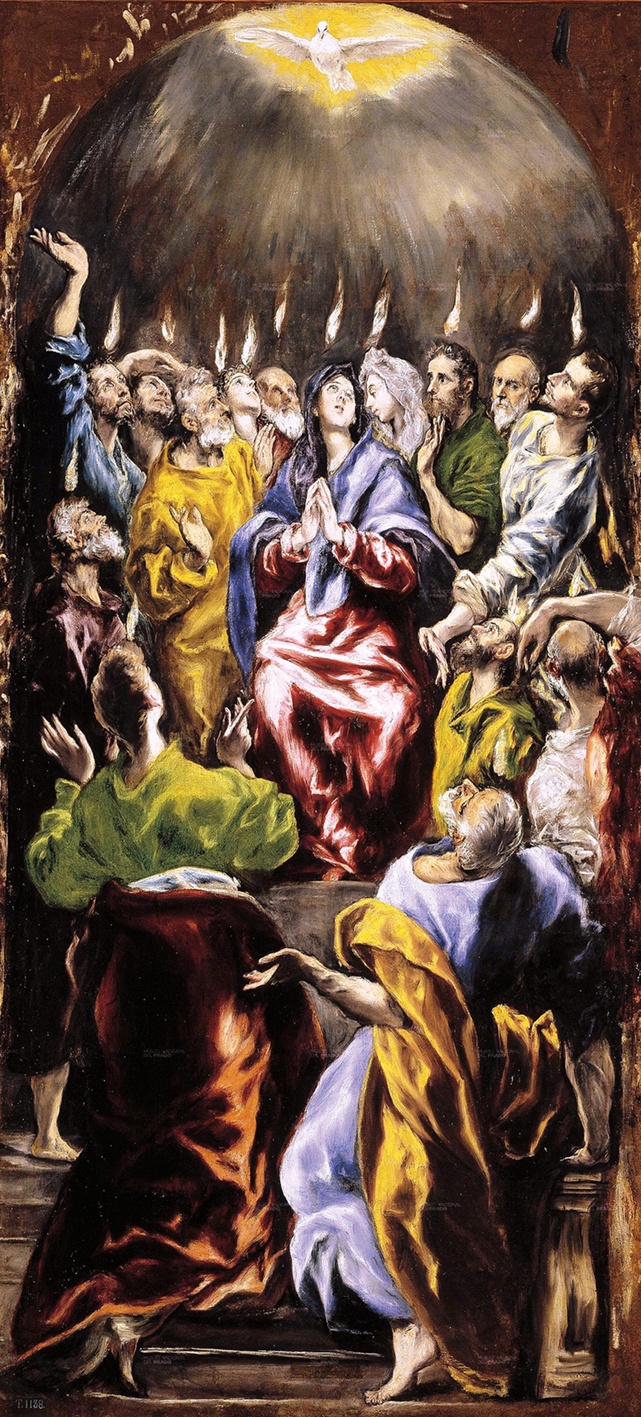
Today, Father Alessio presents El Greco’s “Pentecost,” which can be admired at the Prado Museum in Madrid.

Today I am presenting a work by a unique figure in the history of world art: El Greco’s “Pentecost”. It dates from the end of the 1500s and is now housed at the Prado Museum in Madrid.
An artist of the Spanish Renaissance
Considered one of the leading figures of the Spanish Renaissance, the artist from Crete arranges the figures according to an inverted triangle. The elongated figures depart from the conventions of classical art. His painting, in fact, is not intended to render reality faithfully, but to represent the grace contained within it.
The glowing Upper Room
We are introduced into the Upper Room, whose furnishings, walls, and windows cannot be seen, but everything glows with light, pulsing like wax struck by a fiery wind.
The darkness recalls the fear the disciples experienced during the painful events surrounding Jesus’ death. Now, with the coming of the Holy Spirit, everything vibrates with light, and the group of apostles regathers around Mary. “They were all together in the same place.”
The redemption of the past and the new existence inaugurated by Jesus
The past is redeemed, renewed, not through personal efforts, but through the new existence inaugurated by Jesus and now made possible by the Holy Spirit, who, like a dove, radiates light that illuminates the entire scene and its figures. “Suddenly a sound like the rush of a violent wind came from heaven and filled the entire house where they were staying. They saw what seemed to be tongues of fire that separated and came to rest on each of them.”
The gaze toward the Spirit
Everyone looks toward a higher point, toward the Spirit who unites them all. El Greco, following Saint Paul’s teaching, invites you to look upward: “Set your minds on things above, where Christ is seated at the right hand of God; think about things above, not about things on earth.”
There are fourteen figures: eleven apostles and three women, including Mary Magdalene, near Mary, the mother of Jesus. Fourteen, like the numerical value of David’s name. The promises made to David have been fulfilled: a new people will praise the Lord. A people bearing the mark of human imperfection: eleven apostles instead of twelve; Judas is missing, the apostle who decided to betray Jesus. This painful absence is filled by Mary, who completes that scandalous eleven.
Mary: the caring Mother
If you look closely, you can notice the outline of a column on the right, near the apostle seen from behind with his head tilted back. It is the small column at the beginning of a staircase handrail. At the top stands Mary, not beyond the apostles, but among them. She is a caring mother among her children. She cares about their needs and intervenes with a woman’s tenderness. From the cross, Jesus entrusted her with a noble and extremely demanding task: to be a mother and help every person along the journey of life. Beyond your fears, beyond your darkness, higher up there is a mother who cares about your happiness. Above all, she cares about the well-being of her children. She helps you grow, face life, and be free. El Greco paints Mary’s robe red with a blue mantle, colors that indicate humanity cloaked in divinity: “The Holy Spirit will come upon you, and the power of the Most High will overshadow you.” Like the woman of the Apocalypse, she is dressed in light, with her legs distinctly spread apart, like a woman preparing to give birth. Therefore, if you are tossed about by the waves of tribulation, as Saint Bernard said, look to the star, turn to Mary; she hears you!


