




The collaboration between Don Alessio Fucile, an art expert, and the Shalom blog continues. Don Alessio will guide us in exploring the most important moments of the liturgical year through beautiful works of art that, besides inspiring wonder at their splendor, can help us better understand the Holy Scriptures and Jesus’ message.
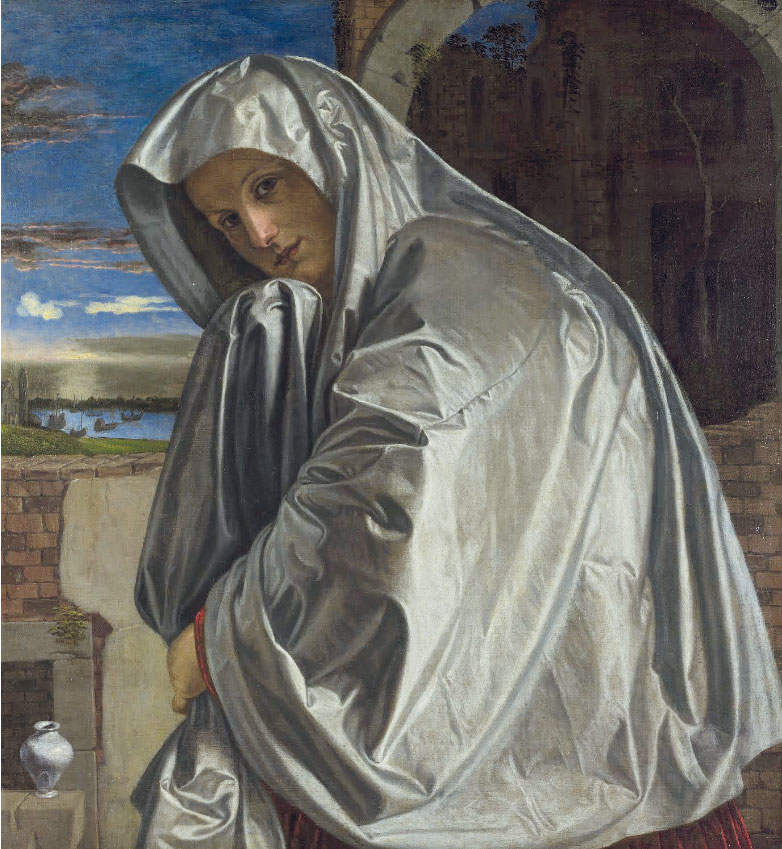
Don Alessio presents today a truly original work in the Renaissance artistic panorama: Mary Magdalene by the Brescian painter Girolamo Savoldo, painted in 1535 and held at the National Gallery in London. Savoldo combines Lombard naturalism with the colorism of the Venetian school. The subject attracted considerable interest among private patrons of the time, so much so that the painter produced at least four versions of it. In the background is a verdant landscape with a body of water that may have been inspired by the Venetian lagoon, with its characteristic boats.
The Figure of Mary Magdalene
Mary Magdalene was the first to see Jesus after the Resurrection at dawn on Sunday, while it was still dark. The Gospel tells us that, in her troubled life, she was possessed by seven demons, from whom Jesus freed her, restoring the purity of her soul. Here the painter depicts her in an unusual pose, with a vaguely sensual attitude, perhaps a reminder of an ambiguous past, and her head gently inclined, almost as if seeking a comfort that would allow her to meditate peacefully.
Symbolism and Details
At first light, the cloak and the small jar of perfumes stand out, still bathed in the silvery light of the moon. Between these two poles lies the whole life of Mary Magdalene, all her drama and, at the same time, all her longing. Her questioning gaze, which she directs at us, is striking—so direct and so realistic that we can still feel it on us even after we have turned away. She seems intent on revealing a secret she carries in her heart: “I have found meaning, a solution to my wounded and disordered life, and this solution is beside you, but you do not see it. It is the risen Jesus!” She presses us with her questioning gaze: “Why do you keep running away, turning your back?”
The question stays with you, like the gaze of this Magdalene. We avoid it by seeking refuge in what surrounds her: for a moment, we would like to move away from those eyes. The lagoon on the left is so full of life and contrasts with the tomb, which somewhat obstructs the view. On the other side, behind an arch, there is something: a dry tree and ruins. Signs of a world that is declining, weary, and close to death.
The question remains there. You are thus compelled to return to Magdalene’s gaze. It is the gaze of the first person to see the risen Jesus, to hear herself called by name, and to understand that only that voice, so gentle, could redeem her entire past of mistakes and failures.
A thought by Kahlil Gibran
I leave you with a thought by Kahlil Gibran, who puts these words into Mary Magdalene’s mouth: «I was dead, I was a woman who had separated from her soul. I lived separated from this “I” you see now. I was called a prostitute, cursed and envied. When his eyes of dawn looked into my eyes, all the stars of my night were illuminated and I became Miriam, simply Miriam. He looked at me and spoke: You have many lovers, Miriam, but only I love you. The others seek themselves by loving you; I love you only for yourself. The others see in you a beauty that passes more quickly than its years; I see in you a beauty that will never fade. I alone love what is in you and cannot be seen. And he moved away. No man moved like him; he was a morning wind born in my garden and moving eastward, or was he a storm that shook everything to its foundations? I do not know. But that day, the dawn in his eyes killed the dragon that was in me. I became a woman, I became Miriam, Miriam of Magdala».
Thank you for your attention.


