




The collaboration between Don Alessio Fucile, an art expert, and the Shalom blog continues. Don Alessio will guide us in exploring the most important moments of the liturgical year through beautiful works of art that, besides inspiring wonder at their splendor, can help us better understand Sacred Scripture and the message of Jesus.
Don Alessio presents today Raphael’s “Transfiguration,” which can be admired at the Vatican Pinacoteca, depicts the episode that the evangelist Mark recounts in tomorrow’s Gospel.
Welcome. Today I have the honor of presenting Raphael’s “Transfiguration,” an absolute masterpiece and, at the same time, his final work. Commissioned for the cathedral of Narbonne by Cardinal Giulio de’ Medici around 1520, it is now housed in the Vatican Pinacoteca.
Immediately after the Transfiguration, the Gospels recount an episode that begins in darkness: the encounter with a demon-possessed boy. No one had been able to help that boy tormented by evil, not even the nine apostles who had not taken part in the Transfiguration on the mountain.
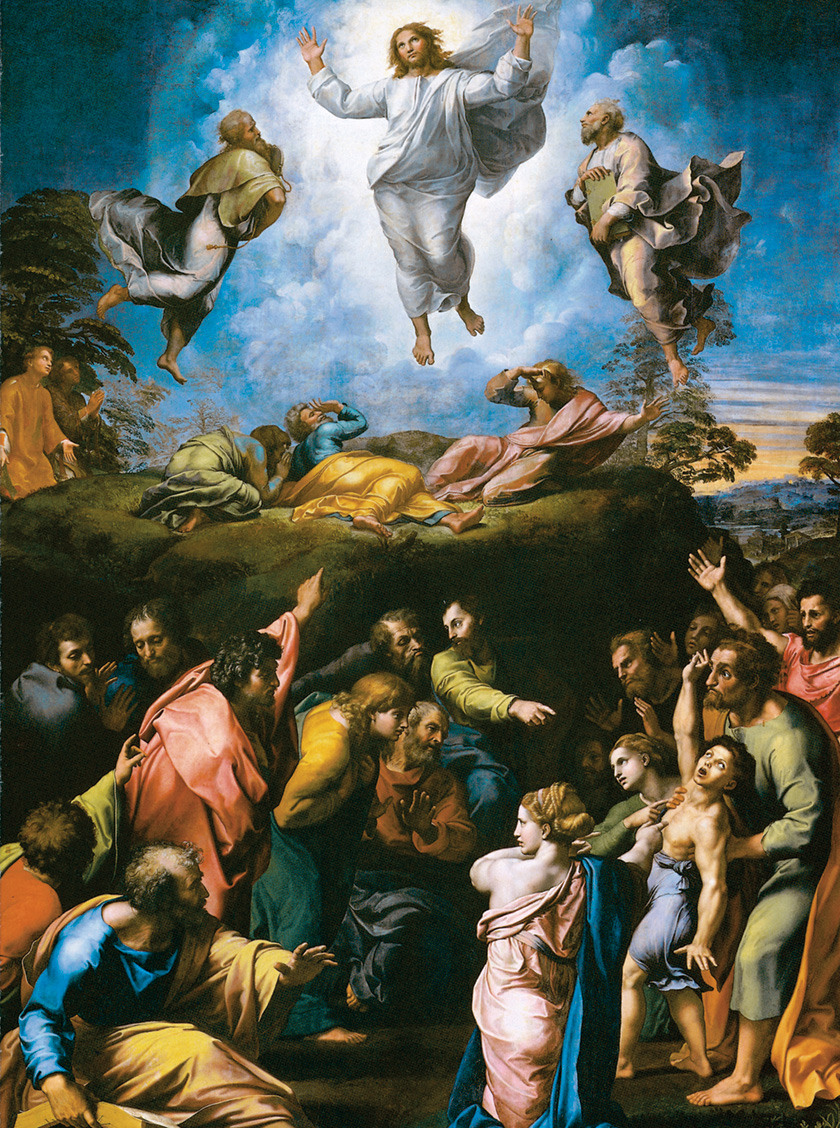
Raphael was the first and only artist to attempt to depict the two events. Above, Christ’s luminous transparency shines forth, an image of the destiny of glory awaiting every human being; below, the darkness of the drama shared by all and each of us prevails, marked by fear and conflicted hope. The boy possessed by evil, like every living person, asks to be saved from the misfortune that oppresses and ravages him. Those beside him would like to help him; they know that his salvation is also theirs. But only Christ can save, as the evangelist on the left shows by extending his hand to indicate the Transfigured Christ on Tabor. Dark, dramatically realistic, almost Caravaggesque tones characterize the lower section. Above, light triumphs. Light is the word of Christ the Savior. That is why his face shines like the midday sun. It is moving to think that Raphael devoted the final hours of his conscious life, before falling into a coma and dying, to painting Christ’s face.

Mount Tabor: the place of ascent and glory
On the mountain, on the left, are Saints Felicissimus and Agapitus, to whom the cathedral of Narbonne is dedicated. Celebrated on August 6, the feast of the Transfiguration, they appear kneeling in contemplation of Christ.
Mount Tabor, traditionally considered the site of the miracle, is depicted as a small promontory. The place recalls the importance of climbing and overcoming the law of gravity. This law is not only external and physical; unfortunately, it is also a tension within us. If you do not apply yourself to life, you begin to descend. It is not instinctive to climb; descending is instinctive! It is difficult for an adult to rise without setting rules for themselves and constantly examining themselves. Climbs are not attractive; they require training, effort, and attention. Life means climbing upward without ever saying, “I have arrived.” Is it not true that life means climbing upward without ever saying, “I have arrived”?
“He took them aside, by themselves” (Mt 17:1). On the mountain, in fact, we see only three apostles: Peter, James, and John. These same three will be present at Jesus’ disfigurement in Gethsemane. Before glory, one must pass through the darkness of suffering: “Unless a grain of wheat falls to the ground and dies, it remains only a single grain; but if it dies, it bears much fruit” (Jn 12:24). Life is characterized by pain; there is no life without the cross. People often want to flee from it, but it always precedes and accompanies them. So why not accept the trials and decide to face them?
Jesus’ prayer: the source of transformation
Choosing a secluded place shows the courage to distance oneself from the crowd. This is so that we can rediscover ourselves. Obviously, it is important to stay informed and be aware of what is happening, but there is an urgent need for time to purify the spirit. Moments to be alone with ourselves, to reflect and pray. This requires decisive, concrete choices. To be alone with myself, with my God, to breathe and regain my strength before descending once again among the crowd.
“As he was praying, the appearance of his face changed” (Lk 9:29). During prayer, Jesus is transfigured, and his clothes become dazzling white. White is a symbol of glory. Prayer reestablishes communication with God; it is the divine irruption into the soul, a conversation with the Father. Jesus is a man of prayer. It often occurs at decisive moments: in Gethsemane, before choosing the Apostles… Jesus surrenders himself to it, withdrawing from people to converse with the Father, and for this reason he seeks secluded places, such as the mountain.
The scene of the Transfiguration
Raphael depicts Jesus transfigured and enveloped in light, above all with his arms outstretched, a gesture that recalls the crucifixion. “Per crucem ad resurrectionem.” To his right is Moses with the tablets of the Law, and to his left Elijah holding the books of the prophecies. They sum up the history of Israel: the entire Old Testament converges in Jesus, awaiting this God who will become man and bring salvation to all who desire it. He is between two men, just as he will be between two criminals on the cross.

The apostles present were “overcome by sleep” (Lk 9:32). The scene will be repeated in Gethsemane. It represents the torpor and indolence that often assail and paralyze the vital faculties. Among the Apostles, only Peter looks at the scene; indeed, he describes it in the first person in one of his Letters: “For we did not follow cleverly devised myths when we made known to you the power and coming of our Lord Jesus Christ, but we were eyewitnesses of his majesty. For he received honor and glory from God the Father when the voice came to him from the Majestic Glory: ‘This is my beloved Son, with whom I am well pleased.’ We ourselves heard this voice come from heaven while we were with him on the holy mountain” (2 Pet 1:16-18).
Suddenly the voice falls silent. Jesus remains alone; normality returns, the grayness of everyday life, a time filled with fears and anxieties, the daily struggle for survival. After that magnificent foretaste of heaven, the three apostles return to the precariousness of everyday life, to the contingencies of historical existence.
The Scene of the Possessed Boy
In the lower part is the scene of the boy possessed by a demon, whom the other apostles are unable to free. The boy can be identified by the unnatural movements of his eyes and by the fact that his family members are holding him back. In the foreground, seen from behind, the boy’s mother points out to the apostles that a new crisis is beginning. Raphael’s refinement in portraying her is extraordinary, especially the elegance of her hairstyle. Some have seen in this figure the Faith necessary to obtain the miracle.

The Meaning of the Transfiguration
The Transfiguration is an image of the future glory that awaits humanity. For Saint Paul, the immortality of the soul is not simply a prolongation of earthly existence, but a passage to an infinitely higher existence. Lord Halifax, the British Foreign Secretary, was asked: “What do you feel when faced with death?” He replied with a quip: “Oh, immense curiosity.” The “afterlife” remains forever mysterious, and our curiosity about it is never satisfied. Jesus says to his apostles, saddened by the thought of his imminent death: “I am going to prepare a place for you. I will come back and take you with me, so that where I am, you may be too” (Jn 14:2-3).
Thank you for your attention.


