




The collaboration between Don Alessio Fucile, an art expert, and the Shalom blog continues. Don Alessio will guide us in exploring the most important moments of the liturgical year through beautiful works of art that, besides inspiring wonder at their splendor, can help us better understand the Holy Scriptures and the message of Jesus.
Today Don Alessio presents Lucio Massari’s painting “The Holy Family Hanging Out the Laundry” in preparation for tomorrow’s feast of the Holy Family of Jesus, Mary, and Joseph.
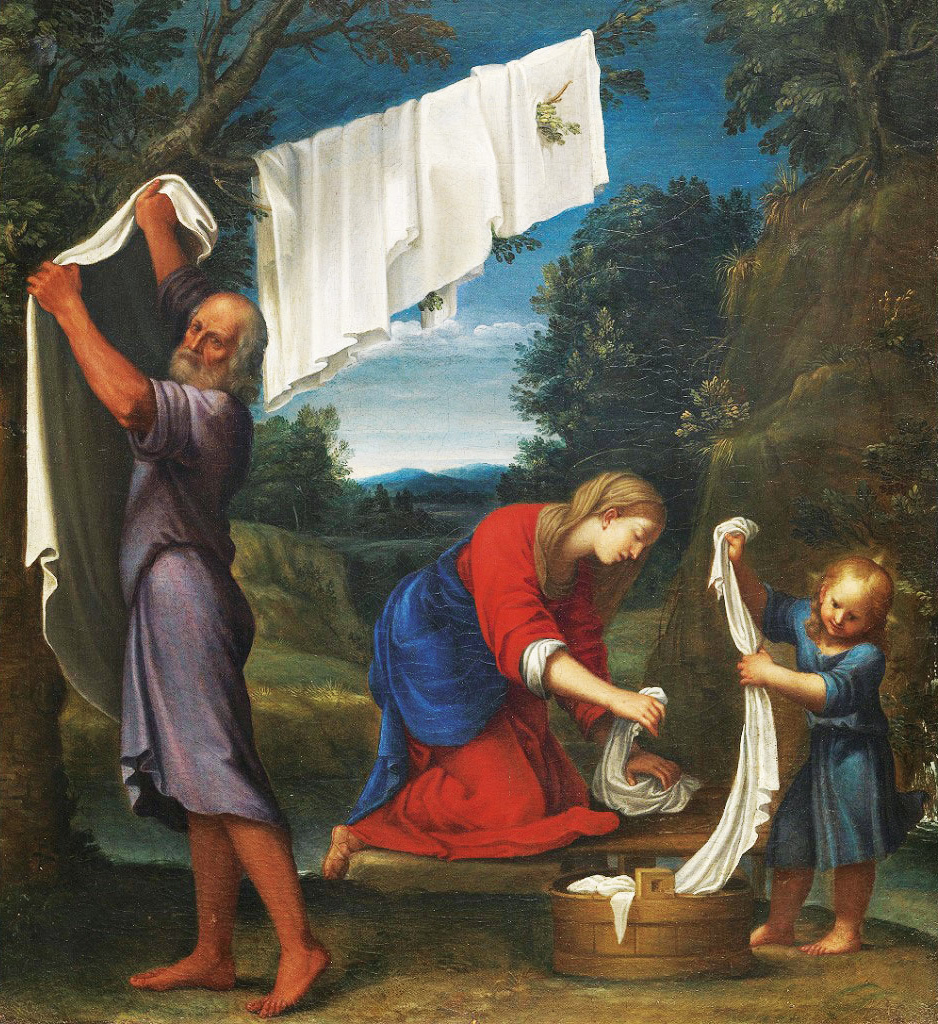
In our feature on the finest works of religious art, we present an original and extremely timely work: “The Holy Family Hanging Out the Laundry,” a painting by the Bolognese painter Lucio Massari, dating from 1620 and housed in the Uffizi Gallery in Florence.
A different scene from usual
The scene depicted is highly unusual: every member of the Holy Family takes part in washing and hanging out the laundry. Further back than the other figures is Mary, kneeling beside a pool of water and washing the clothes; she is dressed in red - the symbolic color of her humanity and of the love she puts into carrying out her mission as a mother and wife - and blue - the color that recalls the divinity with which she has been clothed, as the Gospel recounts: “The Holy Spirit will come upon you” (Lk 1:35). The young Jesus, with a cruciform halo, gathers the washed clothes from a tub and hands them to his father Joseph, who hangs them out to dry on the branch of the nearest tree and looks at us, directly involving us. Some time later, when the parents lose sight of the young Jesus in the Temple, Mary, addressing her son, will say to him: “Why have you treated us like this? Look, your father and I have been anxiously searching for you” (Lk 2:48).

The role of parents
This is a question that expresses the profound pain with which the young parents had to live for three days while searching for Jesus among the crowds of Jerusalem. In those moments of anguish, it was faith that sustained them: often, in fact, trust does not take away even a gram of pain, but it helps us discover a hidden path within the pain itself. Mary’s question seeks to help her son know his father’s heart; indeed, she mentions the husband first: «Your father and I…»; she describes feelings before actions: «Anxious, we were looking for you…».
From this, it seems that a mother’s noble task is to teach her children to esteem their father and to help them know their father’s heart; at the same time, the father’s task is to show his love for the mother and guide the children in showing her affection. The mother speaks well of the father, while the father courts, pampers, and serves the mother, in front of and together with the children; the father organizes surprises for the mother, and she tells them good things about their father and shows that she esteems him. A child’s heart suffers terribly when the mother speaks badly of the father or when the latter is cold or brusque with his wife: if a couple is having difficulties, it is not right for this to weigh on the children, and this is not a matter of hypocrisy but of sensitivity, since in time the children will each form their own judgments.
Family peace
In this everyday scene, Massari shows a harmony and family peace that also reverberates through the surrounding nature. As we observe this tender and moving scene, I would like to leave you with a prayer by Pope Francis: «As we observe this tender and moving scene, we contemplate in Mary and Joseph the splendor of true love and entrust ourselves to them so that our families, too, may be places of communion and prayer».
What do you think of this wonderful painting and its meaning? Tell us in the comments!


