




The collaboration between Father Alessio Fucile, an art expert, and the Shalom blog continues. Father Alessio will guide us in exploring the most important moments of the liturgical year through beautiful works of art which, besides inspiring wonder at their splendor, can help us better understand Sacred Scripture and Jesus’ message.
Today, Father Alessio presents Giotto’s fresco “The Ascension,” which can be admired in Padua’s Scrovegni Chapel, in preparation for tomorrow’s solemnity.


Welcome back. Today I am pleased to present Giotto’s “Ascension,” a fresco located in the Scrovegni Chapel in Padua and dating to around 1303-05.
The scene depicts the last encounter between Jesus and his friends before his ascension: the Gospel of Luke tells us that “Jesus parted from them and was carried up into heaven. And they worshiped him,” and this is how Giotto portrays the event.
The center of the Ascension: Christ’s hands
Everything converges toward Christ’s hands, hidden hands that have already transcended the earthly dimension and are now beyond it. “I am ascending to my Father and your Father”: Jesus finally returns to the kingdom he had left to fulfill his mission of redeeming humanity through his earthly life. Giotto did not miscalculate the space: the same device was used in the fresco of Mary Magdalene’s encounter with the Risen Christ; there too, Jesus’ arm extends beyond the scene. Christ has risen, and his life already belongs to that beyond toward which humanity is headed. Everything converges toward those hands, and the hands of the angels and saints accompanying Christ in his ascent form a “choir” around them. Among them, John the Baptist and the elderly Simeon can be recognized, with his white beard; he had welcomed the infant Jesus when he was presented at the Temple. Jesus definitively opens the way to heaven and restores the relationship between God and humanity that had been interrupted because of sin.
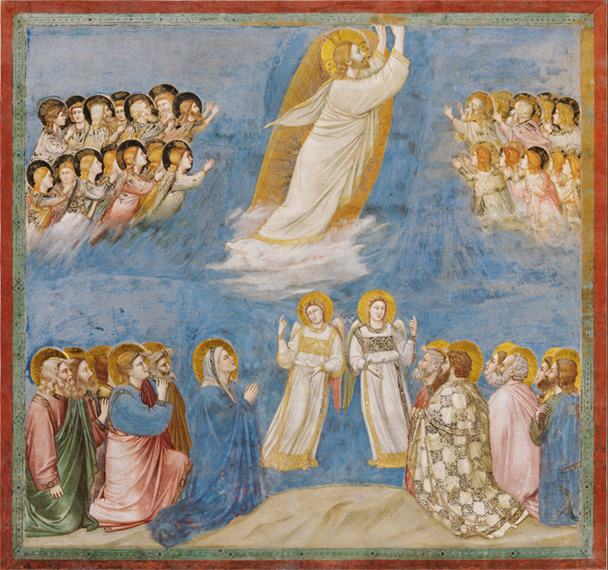
The two angels beneath the Risen One look at the apostles and Mary and instruct them: “Why do you stand looking at the sky? Jesus, who was taken up from among you into heaven, will come in the same way as you saw him go into heaven.”
“While they were watching, he was lifted up, and a cloud took him from their eyes.” There are eleven apostles, since Judas is missing and his replacement, Matthias, has not yet been chosen. They and Mary still remain “under the cloud”: every person is reflected in them, because we too are “under the cloud.” The intensity of their gazes is compelling; the faces are artistically refined, and some figures shield their eyes with their hands to protect themselves from the dazzling light surrounding the mystery of this departure.
The spiritual presence of Christ
Christ hid himself from our sight so that he could shine in our hearts. He does not move away from his own; he is always journeying with humanity. His presence is not physical, limited in space and time, but spiritual, unlimited, everywhere and always. His promise reassures us: “I am with you every day, until the end of the world.”
Giotto painted Mary slightly apart from the group of apostles, portraying her in ecstasy, with a face that is both serene and solemn. The mystery of the Ascension deeply involves her: Jesus’ flesh is her flesh; she is fully a teacher of how to live rooted in history while keeping our eyes fixed on the destiny that awaits us. She teaches us to face life’s sorrows and trials, certain of the triumph that awaits us. Jesus himself declared: “In the world you will have suffering, but take courage because I have conquered the world.”
The Ascension and human destiny
Jesus, who came from the Father, now returns to him, and thanks to the Ascension our life is no longer suspended in nothingness because it has found its beginning and its end; we are not orphans and without a homeland because “our homeland is in heaven and our life is now hidden with Christ in God.”
Thank you for your attention.


